I read The 6-Week Cure for the Middle-Aged Middle the other day. It is written by Dr. Michael R. Eades and Dr. Mary Dan Eades, the authors of all the Protein Power books.
The Drs. Eades were featured in the movie Fat Head, and I really liked everything they were saying, and disagreed with nothing. So when I saw that they had this new (2009) book out, and I have stubborn belly fat, I got the book from the library.
The main point of the book is that, for some people, eating low carb is not enough, and some extra measures need to be taken to detox "fatty liver", also known as Non-Alcoholic Fatty Liver Disease (NAFLD). The book goes into great detail explaining the difference between Subcutaneous Adipose Tissue (SAT) and Visceral Adipose Tissue (VAT), with VAT being the more dangerous to health of the two. SAT is the fat the lives just under your skin, and VAT is the fat that lives in your abdomen and invades your vital organs.
According to the Eades, a fatty liver will not be able to deal with VAT because it is being overtaxed dealing with toxins and fat within itself. Detoxing the liver, and getting the fat out of the liver, will very quickly return it to health and give it a chance to do its job, and VAT will be decreased.
So far, it's sounding pretty good, right?
Next up in the book was the method used to heal NAFLD: The first two weeks of the plan involve drinking a special protein shake three times each day plus one very low carb meal once per day. The calories for the day are around 1400, with 86g fat (55% of total calories), 127g protein (36% of calories) and 30g carbohydrate (9% of calories). This information is not given in the book - I input what was suggested for a woman my size into www.fitday.com to get the values. So this is definitely a lower calorie diet than what I am used to. According to the book, the caloric restriction in combination with the Leucine is supposed to burn fat while preserving muscle. During this two weeks, no caffeine, alcohol and certain drugs are permitted.
I googled Leucine, and found that it is a supplement taken by body builders to burn fat and increase muscle. One of the effects of Leucine is to supress the appetite so that you are not starving while your calories are being reduced.
The shake is any low carb protein shake you like, plus heavy cream, a little sweetener (optional) and a nice big dose (2500mg) of the amino acid l-Leucine. Leucine is supposed to preserve muscle while the body is burning fat. As an alternative to Leucine, you can use Branch Chain Amino Acids (BCAA), which contain l-Leucine, l-Isoleucine and l-Valine. Either the Leucine or the BCAA can be taken in powder that you mix into a shake or water, or in capsule form.
The next two weeks of the plan involve eating a very low carb, low calorie diet consisting of three meals (and snacks, if you like) that exclude all dairy. Caffeine and alcohol are permitted back in moderation. I have not figured out the breakdown of macronutrients for this period, but looking at the suggested meal plans, it looks like what I am already eating. One difference in the "meat weeks", as they are unofficially referred to, is that carbs are restricted to less than 20 or so net carbs, and that would consist of vegetables.
The final stage of the plan is very similar to Atkins Lifetime Maintenance, with dairy being allowed.
The book says that you can find information and a special 6WC forum at the Protein Power (PP) website, but when I went there, I found that, although the Eades had intended to create this forum, they had not actually done it. I went to the regular PP forum, and found it very inactive, and all the discussion about 6WC had died down almost a year ago.
I tried asking a few questions about it and why it works, and was told that the Drs. Eades are the only ones who know the answers, and that I can try contacting them directly to see if they will answer. I did ask one question on Dr. Michael Eades' blog and got an answer, but my followup questions to him have not been answered. Maybe he will answer in time.
My own personal opinion is that the presence of VAT in my own body may be the reason I have not been able to lose a big portion of my body fat, and why I have a large belly that just won't go down. So I am very interested in trying this, but my main question, which no one on the PP forum could answer, and which Dr. Mike has not answered (yet), is this: Why do I have to drink protein shakes? If the reason behind the success of the plan is the increase of protein and the decrease of fat and carbs along with the supplementation with Leucine, then why can't I just eat whole foods that give me the same breakdown of macronutrients?
The best answer - actually, the only answer - I got on the PP forum was a variation of "Don't worry your pretty little head about why you can't just eat food in the right breakdown of fat, protein and carbs. Just do it and don't ask questions!"
Hmmm... That's not good enough for me, and I am not willing to hand over the responsibility for my health to someone who wrote a book and will not tell me why it works.
But, in the interest of possibly getting rid of my belly, once and for all, and decreasing my VAT, which is really dangerous to my health, I have decided to try my own adaptation of the 6-week cure. Here is what I plan to do, and as a matter of fact, I started yesterday:
I am going to eat a combination of real food and only one daily shake and take BCAA. I will eat bacon and eggs with butter for breakfast, along with BCAA, a shake and some fiber for lunch, along with BCAA, and some sort of fresh protein and veggies for dinner, along with BCAA.
The way I was eating:
1800 calories
137g fat (69%)
107g protein (23.5%)
34g total carbs (7.5%)
16g fiber
18g net carbs
The way I will eat for the next two weeks:
1400 calories
86g fat (55%)
127g protein (36%)
30g total carbs (9%)
20g fiber
10g net carbs
Basically, I will be cutting fat by 51 grams, increasing protein by 20 grams and my carbs will be staying pretty much the same. It's actually not that different than what I was advised by Colette Heimowitz, the Atkins nutritionist, to do this past summer. Atkins Induction fat intake is supposed to be 60-70%, and mine will be 55% - very slightly lower, and still a far cry from low fat or even moderate fat. And the protein recommended in the new Atkins book for a woman my height is 71-149 grams per day, so at 127, I am within that range.
Using my new body fat calculator (in the right hand column on this blog), my starting point yesterday morning was this:
141.6 pounds
30.75" waist
12.5" neck
40" hips
25.1 BMI
0.49 waist-to-height ratio
0.77 waist-to-hip ratio
33.7% body fat (47.7 pounds)
66.3% lean mass (93.9 pounds)
As time goes on, I will give an update on how it is going. So far, so good, in that I did this yesterday, and I was not hungry. However, I found the taste of the BCAA pretty disgusting - kind of like grinding up a nasty-tasting pill and putting it in your mouth. But not so gross as to not do it.
One thing did happen yesterday, and I don't know how much of it to ascribe to the BCAA - After my first dose with breakfast, I felt somewhat energized, which is what all the google information said would happen. But after working out and having lunch and more BCAA, I suddenly got tired. Maybe it was just the workout. But then, when I took the BCAA after dinner, I got sleepy. There was no doubt about it this time!
I'll let you know if I have the same experience today, on a non-workout day.
Monday, November 15, 2010
Sunday, November 14, 2010
NOVEMBER 14 - WEEK 87 RESULTS
One week ago, my actual scale weight was 142.2.
Today, my actual scale weight is 141.6.
I lost 0.6 pounds this past week.
One week ago, my average weight for the week was 142.9.
Today, my average weight for the week is 142.9.
I lost 0 pounds this past week.
I tracked my food on fitday every day this past week, and here are the averages of what I ate:
1800 calories
137.2g fat (69%)
106.9g protein
34.4g total carbs
16.4g fiber
18g net carbs, of which 10.7g were from veggies
2766g sodium
Today is my weekly measuring day. In the past 7 days:
I gained 1/2" around my bicep
I lost 1/4" around my waist
I lost 1/4" around my navel
I gained 1/4" around my calf.
I gained 1/2" around my bicep
I lost 1/4" around my waist
I lost 1/4" around my navel
I gained 1/4" around my calf.
To get back to my smallest size on June 13, 2010, I need to lose:
1/4" from my bust
1/4" from my waist
1/4" from my navel
1-1/4" from my hips
1/4" from my thigh
Here is what I have lost so far, since starting to lose weight in February 2009:
Neck - 13.75" to 12.5" - down 1.25"
Bicep - 11.75" to 11.75" - lost fat and gained muscle
Forearm - 9" - no change
Bust - 38.25" to 35.75" - down 2.5"
Midriff - 32.25" to 29.5" - down 2.75"
Waist - 31.5" to 29" - down 2.5"
Navel - 38.25" to 32.25" - down 6"
Hips - 42" to 39.5" - down 2.5"
Thigh - 24.5" to 22.25" - down 2.25"
Calf - 14.5" to 13.75" - down 0.75" - lost fat and gained muscle
BODY COMPOSITION
AT THE BEGINNING OF WEIGHT LOSS 2/22/09
158 pounds
35" waist
13.75" neck
45.5" hips
28.0 BMI
0.56 waist-to-height ratio
0.77 waist-to-hip ratio
44.8% body fat
TODAY
141.6 pounds
30.75" waist
12.5" neck
40" hips
25.1 BMI
0.49 waist-to-height ratio
0.77 waist-to-hip ratio
33.7% body fat
So far, I have lost 16.4 pounds on the scale, 4.25" around my waist, 1.25" around my neck and 5.5" around my hips. I have lost 23.1 pounds of fat and I have gained 6.7 pounds of lean mass.
MY NEXT GOAL
140 pounds
30" waist
12.5" neck
39.75" hips
24.9 BMI
0.48 waist-to-height ratio
0.75 waist-to-hip ratio
32.5% body fat
To achieve this, I need to lose 2.2 pounds of fat and gain 0.6 pounds of lean mass. I need to lose 3/4" around my waist and 1/4" around my hips.
MY ULTIMATE DREAM GOAL
130 pounds
26.5" waist
12.5" neck
37.5" hips
23.1 BMI
0.42 waist-to-height ratio
0.71 waist-to-hip ratio
25% body fat
To achieve this, I need to lose 15.2 more pounds of fat and gain 3.6 more pounds of lean mass. I need to lose another 4.25" around my waist and another 2.5" around my hips.
If I reach this goal, I will have lost a total of 38.3 pounds of fat and gained a total of 10.3 pounds of lean mass since my highest weight on February 22, 2009. I will have also lost 8.5" around my waist, 1.25" around my neck and 8" around my hips.
Saturday, November 13, 2010
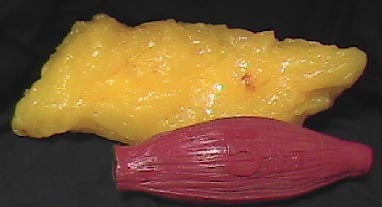
MUSCLE DOES NOT WEIGHT MORE THAN FAT
Muscle does not weigh more than fat - five pounds is five pounds - but it is much nicer to look at! |
|
| As you can see, the 5 lbs. of fat is much bulkier than the 5 lbs. of muscle, but five pounds is still five pounds. Muscle does not weigh more than fat. Fat is bulky and lumpy so if you carry an extra five pounds of fat, you'll be lumpier than with five pounds more muscle. A five pound pile of fat will take up more space (volume) than a five pound pile of muscle; but five pounds is still five pounds, so for those of you that don't "get" English, you cannot say one thing weighing a certain weight weighs more than another thing at that same weight. It's a common joke to play on an 8-year old. The correct way to state the muscle weighs more than fat scenario is, "Muscle is heavier by volume than fat." A woman weighing 150 pounds with 19% fat will look much smaller (and be much healthier) than a woman at 150 pounds with 35% fat. They weigh the same, yet the composition is different. Because muscle is more dense than fat the person with less fat and more muscle will look smaller. Stop being so obsessed with body weight and start paying attention to body composition. How much body fat do you have compared to muscle? Simply seeing how much you weigh isn't very helpful. To read the full article, click here. |
Thursday, November 11, 2010
Monday, November 8, 2010
MY NEXT MINI GOAL - 140 POUNDS WITH 33.7% BODY FAT
I've been playing around with my new Body Fat Percentage Calculator (look right and scroll down to the yellow calculator) and tried to come up with a new goal.
I've always just thought of weight loss as a number on a scale, and never considered it an amount of inches. Who knows how big my waist would be at a certain weight? Well, I input different numbers, and came up with something I think might be reasonable.
140 pounds
30" waist
12.5" neck
39.75" hips
24.9 BMI
0.48 waist-to-height ratio
0.75 waist-to-hip ratio
32.5% body fat
To achieve this, I need to lose 4.5 more pounds of fat, I need to gain 1.6 pounds of muscle and I need to lose 1" from around my waist and 1" from around my hips. I do not have a time frame for this goal - I learned a long time ago that my body will do what it's going to do in its own time. However long it takes, it takes.
These numbers really seem possible, especially now that I am working out again, and it's helpful to see how that would really look on my body, instead of just looking for a number on the scale.
If all goes well and I hit this goal, I will try for another 3 pounds and another 3% off of my body fat.
I've always just thought of weight loss as a number on a scale, and never considered it an amount of inches. Who knows how big my waist would be at a certain weight? Well, I input different numbers, and came up with something I think might be reasonable.
140 pounds
30" waist
12.5" neck
39.75" hips
24.9 BMI
0.48 waist-to-height ratio
0.75 waist-to-hip ratio
32.5% body fat
To achieve this, I need to lose 4.5 more pounds of fat, I need to gain 1.6 pounds of muscle and I need to lose 1" from around my waist and 1" from around my hips. I do not have a time frame for this goal - I learned a long time ago that my body will do what it's going to do in its own time. However long it takes, it takes.
These numbers really seem possible, especially now that I am working out again, and it's helpful to see how that would really look on my body, instead of just looking for a number on the scale.
If all goes well and I hit this goal, I will try for another 3 pounds and another 3% off of my body fat.
Sunday, November 7, 2010
WHOLE FOODS MARKET SAMPLING - BIG MISTAKE!
Boy, did I just blow it! I went to Whole Foods Market and allowed myself to have a few free samples. I keep trying to tell myself that if I do not put it on Fitday, it means it doesn't count.
Here is what I ate at the store:
8 chocolate covered almonds
1/2 oz. of cheese
1/2 slice of multi-grain bread
1 Tbs. pumpkin butter
Now, I had already made up my menu for the day, and there was no room for any of that nonsense. Here is what I am having to add to my day:
303 calories
14.9g fat
18.5g protein
23.6g total carbs
2.6g fiber
21g net carbs!!!! AAAAHHHHHH!!!!!
I will never do that again.
Any time in the past when I have done that, I have always thought, "Well, I'm sure it was not too much." Now I know.
Here is what I ate at the store:
8 chocolate covered almonds
1/2 oz. of cheese
1/2 slice of multi-grain bread
1 Tbs. pumpkin butter
Now, I had already made up my menu for the day, and there was no room for any of that nonsense. Here is what I am having to add to my day:
303 calories
14.9g fat
18.5g protein
23.6g total carbs
2.6g fiber
21g net carbs!!!! AAAAHHHHHH!!!!!
I will never do that again.
Any time in the past when I have done that, I have always thought, "Well, I'm sure it was not too much." Now I know.
LUBRICANT - DR.MICHAEL EADES
QUESTION: Please can you advise on a matter that, although seemingly trivial, is causing some tension in our household. Like many families, rather than spreading butter on our toast at breakfast time, we have switched to one of the supposedly healthier alternative low-fat spreads. Our problem is by what name should we refer to this new product? My wife continues to ask if I’d please pass the butter, but as it isn’t butter, I find this irksome. If I refer to it as margarine, she is annoyed by the implication that we are using some inferior low-quality butter substitute. To request that someone passes the low-fat spread is hardly elegant. Please, Mary, can you advise on the correct terminology?
C.S., Woodbridge, Suffolk
ANSWER: Why not use the word ‘lubricant’? The products to which you refer are, technically, lubricants, and when you have guests they will enjoy laughing at your use of this term.
Hilarious, no? And a great idea. We never, ever use margarine or its low-fat equivalent, but now I wish we did just so I could call it ‘lubricant.’ Perhaps from now on I’ll start asking: Is this butter or is it lubricant?’ The possibilities are endless. I encourage everyone to start using the term.’ Makes this schlock sound like what it really is.
To read the full article by Dr. Eades, right click here.
C.S., Woodbridge, Suffolk
ANSWER: Why not use the word ‘lubricant’? The products to which you refer are, technically, lubricants, and when you have guests they will enjoy laughing at your use of this term.
Hilarious, no? And a great idea. We never, ever use margarine or its low-fat equivalent, but now I wish we did just so I could call it ‘lubricant.’ Perhaps from now on I’ll start asking: Is this butter or is it lubricant?’ The possibilities are endless. I encourage everyone to start using the term.’ Makes this schlock sound like what it really is.
To read the full article by Dr. Eades, right click here.
CAN YOU BE FAT AND HEALTHY?
The content of this video made my head tilt! What do you think?
Labels:
Body Composition,
Exercise,
Fat,
Tom Naughton,
Videos
WHY DO WE GET HUNGRY? TOM NAUGHTON & DRS. EADES
Here is a great video that explains the mechanisms at work in hunger, and how a low carb diet controls hunger.
Labels:
Calories In Calories Out,
Fat,
Tom Naughton,
Videos
NOVEMBER 7 - WEEK 86 RESULTS
One week ago, my average weight for the week was 143.4.
Today, my average weight for the week is 142.9.
I lost 0.5 pounds this past week.
I tracked my food on fitday every day this past week, and here are the averages of what I ate:
1442 calories
112.4g fat
80.9g protein
26.8g total carbs
15.8g fiber
11g net carbs, of which 7.2g were from veggies
2220g sodium
Today is my weekly measuring day. In the past 7 days:
I lost 1/4" around my bust
I lost 1/4" around my midriff
I gained 1/4" around my hips.
I lost 1/4" around my bust
I lost 1/4" around my midriff
I gained 1/4" around my hips.
To get back to my smallest size on June 13, 2010, I need to lose:
1/4" around my bicep
1/4" from my bust
1/2" from my waist
1/2" from my navel
1-1/4" from my hips
1/4" from my thigh
Here is what I have lost so far, since starting to lose weight in February 2009:
Neck - 13.75" to 12.5" - down 1.25"
Bicep - 11.75" to 11.25" - down 0.5"
Forearm - 9" - no change
Bust - 38.25" to 35.75" - down 2.5"
Midriff - 32.25" to 29.5" - down 2.75"
Waist - 31.5" to 29.25" - down 2.25"
Navel - 38.25" to 32.5" - down 5.75"
Hips - 42" to 39.5" - down 2.5"
Thigh - 24.5" to 22.25" - down 2.25"
Calf - 14.5" to 13.5" - down 1"
I would still like to replace some body fat with some muscle, so I'll see how that goes as time goes on.
Saturday, November 6, 2010
TRYING SOMETHING NEW - AGAIN
For the past two weeks, I have reduced my fat, protein and carbs. This is what I have eaten on 12 of the past 14 days:
1440 calories
112g fat
81g protein
27g carbs
16g fiber
11g net carbs, of which around 8.5g have come from veggies
2267g sodium
My reason for dropping down to this low level after eating around 1800 calories per day was to jump start my weight loss after maintaining it for many, many months.
It did not work. My weight is unchanged. Well, actually, I gained almost one pound. The last time I tried this was back in April 2009, and I dropped several pounds very easily, even though it was hard eating that small amount of food. No luck this time. I think two weeks is enough time to try a change.
The thing that bugs me is that, before this past two weeks, I was maintaining my weight eating around 1800 calories per day and 25 net carbs. Now, I am maintaining that same weight eating 1440 calories and 11 net carbs. If the First Law of Thermodynamics applied here, and 3500 calories equals 1 pound, I would have had to have lost at least a pound and a half in this amount of time.
Not only that, but I started exercising moderately two weeks ago, so I should have burned off even more than that. So much for "Calories In Calories Out".
I figure that if I am not going to lose weight anyway, I might as well go ahead a eat like I was before, when I was maintaining my weight on 1800 calories and 25 net carbs.
My plan is to go ahead and increase calories to around 1800, but to only increase net carbs by 1 per day, until I get back up to 25 net carbs. That way, I will avoid the water retention that sometimes comes from increasing carbs too quickly.
So, starting tomorrow morning, I get to eat!!! I was eating so little before that I could only eat two full meals per day!
TURBULENCE TRAINING INTRODUCTORY LEVEL WORKOUT B
Warm-up Circuit
Go through 2 times with no rest between exercises.
Rest 30 seconds between circuits.
Lying Hip Extension – 5 repetitions
Kneeling Pushup – 5 repetitions
Stability Ball Leg Curl – 5 repetitions
Superset #1
1A) Step-ups – 8 repetitions per side
No rest.
1B) Stick-ups – 12 repetitions
Rest 1 minute & repeat 1 more time for a total of 2 supersets.
Superset #2
2A) Stability Ball Leg Curl – 8 repetitions
No rest.
2B) Kneeling Push-up – 8 repetitions
Rest 1 minute & repeat 1 more time for a total of 2 supersets.
Superset #3
3A) Prisoner Squat – 10 repetitions
No rest.
3B) Side Plank – 10 second hold per side
Rest 1 minute & repeat 1 more time for a total of 2 supersets.
Friday, November 5, 2010
FATS AND OILS - TELLING THE GOOD FROM THE BAD
More from Tom Naughton on the history of fats and oils, and how saturated fats have been vilified by the government.
Labels:
Bad Foods,
Cholesterol,
Fat,
Tom Naughton,
Videos
THE MCGOVERN REPORT - HOW DID THIS ALL START? - TOM NAUGHTON
How did the government first start telling us how to eat? Let Tom Naughton explain this travesty in a most entertaining way!
Labels:
Bad Doctors,
Bad Foods,
Cholesterol,
Fat,
Tom Naughton,
Videos
Thursday, November 4, 2010
MORE BAD SCIENCE? THAT'S EGGSACTLY WHAT IT IS - TOM NAUGHTON
According to a brand-new study, we common folks have a real problem with our diets: namely, we don’t appear to be letting bad scientists scare us away from real foods quite as much as we once did:
The public’s attention is beginning to drift away from the anti-cholesterol message that doctors have been preaching for 40 years, according to the authors of a review in the November 2010 issue of the Canadian Journal of Cardiology.
“A widespread misconception has been developing among the Canadian public and among physicians. It is increasingly believed that consumption of dietary cholesterol and egg yolks is harmless,” Dr J. David Spence and colleagues state.
Hmmm … perhaps the public believes egg yolks are harmless because egg yolks are harmless. After years of making omelets with Egg Beaters and other frankenfoods, it could be that people are thinking to themselves, “You know, my grandma ate eggs every day, and she was 97 before the yolks finally killed her.”
The long-standing recommendation to limit dietary cholesterol is still important, especially for people at risk for cardiovascular disease, but a single egg yolk contains approximately 215 mg to 275 mg of cholesterol, more than the 200-mg daily limit recommended by the American Heart Association and National Cholesterol Education Program, and even more than some infamous fast-food items such as KFC’s Double Down or Hardee’s Monster Thickburger, the authors note.
Allow me to interpret that gobbledygook: Eggs are bad because a single yolk contains more cholesterol than the daily limit recommended by organizations that don’t know diddly about heart disease and believe Cocoa Puffs are good for your heart.
Also, eggs are bad because they contain more cholesterol than foods that don’t actually contain much cholesterol, such as chicken and hamburgers. This is akin to saying strawberries are bad because just 10 of them contain more fructose than 50 pounds of sausage.
“We have become increasingly concerned about the pervasive success of egg marketing propaganda,” including a brochure touting the benefits of eggs promoted by the Heart and Stroke Foundation of Canada, “quoting directly from the egg marketing propaganda,” Spence told HeartWire. “After I received that, I called the HSF and offered to meet with them to discuss the evidence, but I was brushed off as if I were someone they had never heard of.”
Oh, now, I don’t think they brushed you off as if you were someone they’ve never heard of. I’m guessing you were brushed off precisely because they have heard of you. I’ll bet the conversation in their offices went something like this:
“It’s Dr. Spence on the phone. Again.”
“Who?”
“You know, the nut-job who still thinks eggs are killers in spite of all the evidence to the contrary.”
“Oh, him. Uh … tell him we’re busy.”
“Despite widespread belief to the contrary, it is simply not true that dietary cholesterol is harmless,” because research over the past 40 years supports reducing dietary cholesterol to reduce LDL levels, which in turn reduces coronary risk, according to the authors.
Ah, yes … teleoanalysis in action. In case you didn’t watch the video of my Big Fat Fiasco speech, here’s how teleoanalysis works:
We cannot prove, in spite of many clinical-study attempts, that A (low-cholesterol diet) causes C (reduction in heart disease). But … if we can prove that A (low-cholesterol diet) sometimes leads to B (lower cholesterol in the blood) and B (lower cholesterol via statins) sometimes leads to C (reduction in heart disease), we can still claim that A causes C.
So that proves egg yolks will kill you … see?
The only trouble with Dr. Spence’s logic (besides the fact that teleoanlysis is utter hogwash) is that several studies have shown no connection between the amount of cholesterol you consume and the level of cholesterol in your blood — even Ancel Keys eventually admitted that fact. And of course, the link between high cholesterol and heart disease is about as statistically weak as you can get.
Epidemiological studies of egg consumption that failed to show a link between eggs and cardiovascular disease in healthy people were not powered to show an effect in healthy people …
Allow me to interpret again: dangit, if only we’d had a chance to crunch the numbers ourselves, we could have “powered” the data into producing the result we wanted.
… but did show an increased risk of cardiovascular disease with egg consumption among diabetics.
Or as a separate article in Science Daily about the same study explained:
The authors point out that in both studies, those who developed diabetes while consuming an egg a day doubled their risk of cardiovascular disease compared to those eating less than an egg a week.
We’ve covered those observational studies before. Eggs were associated with heart disease among people who also developed type 2 diabetes, but not among those who didn’t. In other words, the link only shows up in people with lousy diets overall.
Those would be people Dr. Mike Eades calls “non-adherers” and I call “people who don’t give a @#$%.” They don’t care if eggs are (supposedly) bad for them. They also don’t care if sugar is bad for them, or if smoking is bad for them. One of the studies noted specifically that the subjects who consumed more than one egg per day were also older, fatter, and more likely to smoke.
The studies also showed a significant increase of new onset diabetes with regular egg consumption.
Wowzers … such bad-science thinking, they didn’t even bother with the phrase “was associated with” this time. Read that sentence without knowing any better, and you’d think eating eggs causes diabetes. So let’s see how that idea holds up against actual evidence.
In the chart below, I plotted the rate of diabetes over the past several decades (in red), along with the per-capita consumption of eggs during the same period (in blue).

Hmmm … looks like back in the 1950s, when egg consumption was far higher than it is today, we had an amazingly low rate of diabetes. It would also appear that diabetes rates went up while per-capita egg consumption was going down. So what can we conclude from this? Thinking … thinking … aha, I’ve got it! — eggs don’t actually cause diabetes, or we’d see consistent and repeatable evidence that they do. No consistency, no scientific validity.
The authors conclude, “There is no question that egg white is classed as a valuable source of high-quality protein. Egg yolks, however, are not something that should be eaten indiscriminately by adults without regard to their global cardiovascular risk, genetic predisposition to heart attacks and overall food habits.”
The blogger concludes: the authors are lousy scientists
To read Tom's full article and leave a comment, right click here.
CARBS AGAINST CARDIO: MORE EVIDENCE THAT REFINED CARBOHYDRATES, NOT FAT, THREATEN THE HEART
Whether the new thinking will be reflected in this year's revision of the federal dietary guidelines remains unclear
Eat less saturated fat: that has been the take-home message from the U.S. government for the past 30 years. But while Americans have dutifully reduced the percentage of daily calories from saturated fat since 1970, the obesity rate during that time has more than doubled, diabetes has tripled, and heart disease is still the country’s biggest killer. Now a spate of new research, including a meta-analysis of nearly two dozen studies, suggests a reason why: investigators may have picked the wrong culprit. Processed carbohydrates, which many Americans eat today in place of fat, may increase the risk of obesity, diabetes and heart disease more than fat does—a finding that has serious implications for new dietary guidelines expected this year.
In March the American Journal of Clinical Nutrition published a meta-analysis—which combines data from several studies—that compared the reported daily food intake of nearly 350,000 people against their risk of developing cardiovascular disease over a period of five to 23 years. The analysis, overseen by Ronald M. Krauss, director of atherosclerosis research at the Children’s Hospital Oakland Research Institute, found no association between the amount of saturated fat consumed and the risk of heart disease.
The finding joins other conclusions of the past few years that run counter to the conventional wisdom that saturated fat is bad for the heart because it increases total cholesterol evels. That idea is “based in large measure on extrapolations, which are not supported by the data,” Krauss says.
One problem with the old logic is that “total cholesterol is not a great predictor of risk,” says Meir Stampfer, a professor of nutrition and epidemiology at the Harvard School of Public Health. Although saturated fat boosts blood levels of “bad” LDL cholesterol, it also increases “good” HDL cholesterol. In 2008 Stampfer co-authored a study in the New England Journal of Medicine that followed 322 moderately obese individuals for two years as they adopted one of three diets: a low-fat, calorie-restricted diet based on American Heart Association guidelines; a Mediterranean, restricted-calorie diet rich in vegetables and low in red meat; and a low-carbohydrate, nonrestricted-calorie diet. Although the subjects on the low-carb diet ate the most saturated fat, they ended up with the healthiest ratio of HDL to LDL cholesterol and lost twice as much weight as their low-fat-eating counterparts.
Stampfer’s findings do not merely suggest that saturated fats are not so bad; they indicate that carbohydrates could be worse. A 1997 study he co-authored in the Journal of the American Medical Association evaluated 65,000 women and found that the quintile of women who ate the most easily digestible and readily absorbed carbohydrates—that is, those with the highest glycemic index—were 47 percent more likely to acquire type 2 diabetes than those in the quintile with the lowest average glycemic-index score. (The amount of fat the women ate did not affect diabetes risk.) And a 2007 Dutch study of 15,000 women published in the Journal of the American College of Cardiology found that women who were overweight and in the quartile that consumed meals with the highest average glycemic load, a metric that incorporates portion size, were 79 percent more likely to develop coronary vascular disease than overweight women in the lowest quartile.
These trends may be explained in part by the yo-yo effects that high glycemic-index carbohydrates have on blood glucose, which can stimulate fat production and inflammation, increase overall caloric intake and lower insulin sensitivity, says David Ludwig, director of the obesity program at Children’s Hospital Boston.
Will the more recent thinking on fats and carbs be reflected in the 2010 federal Dietary Guidelines for Americans, updated once every five years? It depends on the strength of the evidence, explains Robert C. Post, deputy director of the U.S. Department of Agriculture’s Center for Nutrition Policy and Promotion.
Findings that “have less support are put on the list of things to do with regard to more research.” Right now, Post explains, the agency’s main message to Americans is to limit overall calorie intake, irrespective of the source. “We’re finding that messages to consumers need to be short and simple and to the point,” he says. Another issue facing regulatory agencies, notes Harvard’s Stampfer, is that “the sugared beverage industry is lobbying very hard and trying to cast doubt on all these studies.”
Nobody is advocating that people start gorging themselves on saturated fats, tempting as that may sound. Some monounsaturated and polyunsaturated fats, such as those found in fish and olive oil, can protect against heart disease. What is more, some high-fiber carbohydrates are unquestionably good for the body. But saturated fats may ultimately be neutral compared with processed carbs and sugars such as those found in cereals, breads, pasta and cookies.
“If you reduce saturated fat and replace it with high glycemic-index carbohydrates, you may not only not get benefits—you might actually produce harm,” Ludwig argues. The next time you eat a piece of buttered toast, he says, consider that “butter is actually the more healthful component.”
To read the entire article, plus the comments left by readers, right click here.
TURBULENCE TRAINING INTRODUCTORY LEVEL WORKOUT A
Warm-up Circuit Go through 2 times with no rest between exercises. Rest 30 seconds between circuits. Lying Hip Extension – 5 repetitions Kneeling Pushup – 5 repetitions Superset #1 1A) Lying Hip Extension – 8 repetitions No rest. 1B) Plank – 15 second hold Rest 1 minute & repeat 1 more time for a total of 2 supersets. Superset #2 2A) Bodyweight Squat – 10 repetitions No rest. 2B) Bird Dog – 5 repetitions per side Rest 1 minute & repeat 1 more time for a total of 2 supersets. Superset #3 3A) Kneeling Pushups – 8 repetitions No rest. 3B) Side Plank – 5 second hold per side Rest 1 minute & repeat 1 more time for a total of 2 supersets. Superset #4 4A) Stick-ups – 10 repetitions No rest. 4B) Ab Curl-up – 6 repetitions Rest 1 minute & repeat 1 more time for a total of 2 supersets. To find out more about Turbulence Training, right click here.
Tuesday, November 2, 2010
THE DIET ARGUMENT BY UFFE RAVNSKOV, M.D., PH.D
"Let me take you down, ’cause I'm going to Strawberry Fields,
nothing is real and nothing to get hung about Strawberry Fields forever."
Lennon/McCarthy
Lennon/McCarthy
Saturated fat is the type of fat that dominates in animal food such as eggs, cream, meat and cheese and it is also abundant in palm oil and coconut oil. Today, too much saturated fat is considered just as dangerous to our arteries as are the greasy food leftovers destined for the sewer of our kitchen sink, but where is the evidence? For several years sceptical scientists including myself have asked the experts on the Swedish National Food Administration after the scientific studies that allow them to warn against saturated fat. Their usual answer have been that “there are thousands of such studies”, or they refer to the WHO guidelines,1 said to have been written by the world’s greatest experts.
The main argument in that document is that saturated fat raises cholesterol, but high cholesterol is not a disease. What we want to know is if we are shortening our life or running a greater risk of suffering with a heart attack or a stroke, by eating too much saturated fat. To claim that it raises cholesterol is not enough; this is what scientists call a surrogate outcome. The proposition that high cholesterol is a risk factor for having a heart attack is only a hypothesis, and as I shall tell you later in this book, all the evidence shows that the proposition is plainly wrong. In fact, it is advantageous to have high cholesterol. For instance, more than twenty studies have shown that elderly people, with high cholesterol, live longer than elderly people with low cholesterol. The reader may disbelieve me and I can understand that, especially after everything we have been told about dangerous cholesterol, but it is true.
Recently the Swedish Food Administration published a list of 72 studies that they claimed were in support of their warnings against saturated fat. Together with eleven colleagues I scrutinized the list and what we found was that only two of them were in support.
Eleven studies did not concern saturated fat at all.
Sixteen studies were about saturated fat, but were not in support.
Three reviews had ignored all contradictory studies.
Eleven studies gave partially or doubtful support.
Eight studies concerned reviews of experiments where the treatment included not only a “healthy” diet, but also weight reduction, smoking cessation and physical exercise. So how did they know whether the small effect was due to less saturated fat or to something else? Furthermore, all of them had excluded trials with a negative outcome.
Twenty-one studies were about surrogate outcomes. In most of them the authors claimed that saturated fat raises cholesterol. But again, high cholesterol is not a disease.
Twelve studies were listed because they had shown that people on a diet which included a high proportion of saturated fat and little in the way of carbohydrates, reacted more slowly to insulin than normally. From that observation, the authors claimed that saturated fat causes diabetes. It is a normal reaction however, that if you cut the intake of carbohydrates radically, your metabolism is changed to spare blood glucose. Saturated fat does not produce diabetes. More than a dozen experiments have shown that the best cure for people with type 2 diabetes is a diet with much saturated fat and little carbohydrates. In a few days their blood sugar normalises and many of the patients are able to stop their medication.2 Another contradiction is, that for many years the consumption of saturated fat has decreased in many countries, while during the same time period we have seen a steady increase in the incidence of type 2 diabetes.
To their honour the Food Administration published another list with eight studies which they said contradicted their warnings. However, that list was incomplete, to put it mildly.
Why didn’t they include the many studies of the Masai people who have the lowest cholesterol ever measured in healthy people, although more than sixty percent of the calories in their food are derived from saturated fat.3
Why didn't they mention that cholesterol in people who gorge on saturated fat on average is not higher than those who avoid it as if it was poison?4
Why didn’t they mention the more than thirty studies, which had shown that patients who had suffered a myocardial infarction or a stroke had NOT eaten more saturated fat than healthy individuals.4
Why didn’t they mention the nine studies which had shown that patients who had suffered a stroke hade eaten less saturated fat than healthy individuals?5
Why didn’t they mention any of the many unsuccessful dietary trials? If a high intake of saturated fat causes heart disease, a reduction of the intake should of course lower the risk. Until 1997 nine such trials had been published and when all the results were put together in a so-called meta-analysis, no reduction of saturated fat in the diet was seen to have any effect whatsoever. In a few of the trials fewer died from myocardial infarction, but in just as many mortality increased.4,6
Why is saturated fat still seen as a menace to health today? What is the evidence for this idea?
The truth is that there is none. The truth is that the warnings against saturated fat are based upon manipulated data.
Ancel Keys
Ask any scientist in this area to list the names of those who have created the diet-heart idea and nine out of ten probably put the name Ancel Keys on the top.
Keys had no clinical experience; he was an American professor in physiology. One of his first contributions in this area of science was a paper from 1953 where he stated that myocardial infarction was caused by too much fat in the diet. As an argument he used a diagram showing the association between fat consumption and the mortality from heart disease in six countries. It looked very convincing, because all of the observations were in accord. On top were the figures from the US; at the bottom were those from Japan. In the US people ate five times more fat than in Japan, and heart mortality was fifteen times higher. The data from the other countries lay between those two data points, forming a beautiful curve starting in the lower left corner and ending in the upper right.7
What Keys was apparently unaware of was that the figures for fat consumption, which he had collected from the archives in FAO, did not reflect what people eat, but the amount of fat which was available for consumption. This is certainly something else because much of the available fat never reaches the human stomach. Some is eaten by rats, some is given to cats, dogs and other pet animals, and some is thrown away because of bad storage. In rich countries, where fat is considered synonymous with poison, most fat probably disappears in the kitchen or is cut away on the plate. In poor countries, where malnutrition and famine is a greater problem than heart disease, all fat is eaten.
The figures for the number of people who die from myocardial infarction is just as uncertain. These figures were taken from the archives in the World Health Organisation (WHO) and were based on death certificates.
But how often do you think that the diagnosis is correct on that piece of paper? Consider the fact that there is only room for one diagnosis on a death certificate. In most countries, less than ten percent of dead people are examined by a coroner. The diagnosis on the certificate therefore reflects what the doctor thinks is the cause of death. That the diagnosis not necessarily is true was shown in a Swedish study by Drs. George D Lundberg and Gerhard Voigt. They found that almost half of those whose cause of death was listed as a myocardial infarction according to the death certificate, had actually died from something else.8
The most serious error in Keys’ paper was that he had excluded data that didn’t fit his hypothesis. I shall tell you more about that in the following. Unfortunately, his paper is still used by to-day’s experts as an argument for their dietary guidelines, as is another one, called Seven Countries; published in 1972.9
In that study Keys had followed sixteen population groups in seven different countries and from his observations, he concluded that one of the most important factors behind myocardial infarction was that there was too much saturated fat in the diet.
If you eat too much, he said, your cholesterol goes up. This was what he and other researchers had seen in their dietary experiments on healthy people. When they ate much saturated fat their cholesterol went up, and vice versa.
His message was swallowed by the rest of the world. Anyone who question this sacred dogma today is considered to be a quack, although lots of scientific studies have shown that it isn’t true.
Keys’ idea was questioned by Raymond Reiser, an American professor in biochemistry, who pointed to several errors in these experiments.10 Instead of giving the test individuals natural saturated fat from animal food, many authors had used vegetable oils saturated by hydrogenation, a process that also produces trans fat, and to-day we know that trans fat does indeed cause cholesterol levels to rise. In addition, when cholesterol went up, researchers attributed the effect to high intakes of saturated fat when in fact it could have been due to low intakes of polyunsaturated fat, and vice versa.
Other researchers have studied this problem in recent time, but most of them have made similar errors. It is simply impossible to draw any valid conclusions about the effect of saturated fat alone from such trials.
What definitely argues against a cholesterol lowering effect from saturated fat is the outcome of modern dietary trials where scientists have used a diet low in carbohydrates with a high content of saturated fat to combat diabetes and/or obesity.11 By avoiding bread, potatoes, cakes, cookies, candies and soft drinks these scientists have achieved amazing results. Even if the diet contained 20-50 percent of calories from saturated fat, there was no effect on the patients´ blood cholesterol.12
But let me return to the Seven Countries paper. Apparently, very few have read the full 260 page report, because if you were to do that meticulously, as I have done, you will soon discover findings that are at odds with the idea proposed by Keys. For example, although the intake was almost equal in the Finnish population groups from Turku and North Karelia, heart mortality was five times higher in North Karelia than in Turku. The saturated fat intake was equal on two Greek islands, Crete and Corfu, but heart mortality was almost seven times higher on Corfu than on Crete.
Keys’ lengthy report is loaded with irrelevant figures and tables and the conflicting findings are easily overlooked. One of the findings was that while the intake of saturated fat was associated with heart mortality, it was not associated with the ECG findings. Those with a pathological ECG had not eaten more saturated fat than the others.
Whom are we to believe? The local doctors who wrote the death certificates, or the American experts who evaluated all the ECGs?
More contradictions
During the eighties, American researcher Ronald Krauss found that the most useful risk marker, the best predictor of myocardial infarction among the blood lipids, wasn’t the total amount of cholesterol in the blood, neither was it the bad guy which is generally accepted to be LDL cholesterol, but a special type of LDL particles, the small and dense ones. The most surprising finding was that if somebody ate much saturated fat, then the number of these small, dense LDL particles was shown to decrease.13
Isn’t that the opposite to what we would expect? Why should we avoid saturated fat if it lowers the risk of dying from a heart attack?
Good question, and this was also my question to Ronald Krauss when I met him in Chicago a few years ago. Krauss is not only a brilliant researcher, he is also a member of the committee who write the dietary guidelines for the American people.
“Oh, you see”, he answered, “the members of the committee do not always agree, and when we don’t agree, we decide what to recommend by voting”.
I wonder if the committee voted when they discussed the study by an Indian researcher, Malhotra. For six years he had registered how many people had died from a heart attack, from among more than one million employees of the Indian railways. According to Malhotra’s report; employees who lived in Madras had the highest mortality. It was six to seven times higher than in Punjab, the district with the lowest mortality, and the people from Madras also died at a much younger age. But people in the Punjab consumed almost seventeen times more fat than people from Madras and most of it was animal fat. In addition they also smoked much more than in Madras.14
Many of the experts in the committee must have been skeptical of Malhotra’s result: “How is that possible? How many of you believe in such nonsense? Raise your hands!”
The answer from the Swedish Food Administration
I assume that you are curious to know how the Swedish Food Administration responded to our criticism. They did respond, but we couldn’t find an answer to our questions about saturated fat. Indeed, we could not even find the term saturated fat in their text. Instead you could read statements such as ”Our dietary guidelines are based on science….they are a synthesis of thousands of studies…they are based on the WHO guidelines.”
Can we rely on the WHO experts?
After almost twenty years of meticulous reading of the scientific reports about this issue I haven’t found any valid argument against saturated fat, and I am not alone.15 Instead, as you know already, there are a large number of contradictory observations. Let us therefore return to the WHO/FAO Expert Consultation1 to see what the world’s best experts have to say about it.
According to that paper, “the relationship between dietary fats and CVD (cardiovascular disease), especially coronary heart disease, has been extensively investigated, with strong and consistent associations emerging from a wide body of evidence”. This statement is followed by a reference to a consensus report from the Nutrition Committee of the American Heart Association.16 The only evidence presented in that report are studies claiming that saturated fat raises cholesterol, and a single study claiming that intake of saturated fat may cause myocardial infarction.17
The first argument is not true, as you know already and the second is not true either. However, in the summary of that paper you can read that “our findings suggest that replacing saturated and trans unsaturated fats with unhydrogenated monounsaturated and polyunsaturated fats is more effective in preventing coronary heart disease in women than reducing overall fat intake.”17
You would probably think that the study was a dietary trial, but it was not. It was a study of 80,000 healthy nurses who had been studied for almost twenty years. At the start of the study and every following year, the researchers from Harvard asked them about their usual diet. At the end of the study the diet of those who had suffered a heart attack was compared with the diet of those who had remained healthy. The term “replacing” did not mean that they had replaced anything; it was a result of complicated statistical calculations based on the dietary information. The truth is, that on average there were just as many heart attacks among those who had the lowest intake of saturated fat as among those with the highest; this fact appears clearly from the tables in their report. Neither has any of the Harvard-researchers previous reports shown that..
Are dairy products dangerous?
Saturated fat is the dominating fat in milk, cream and cheese. This is the reason why everybody praise the lowfat dairy products, both for children and adults. But what does science tell us about that?
In a British report, the authors had put together data from ten large studies including more than 400,000 men and women who had been followed for several years. What they found was that the number of heart attacks and strokes were smaller among those people who had consumed the most dairy products.18
A more reliable method
A relevant argument against such studies is that what the participants tell you about their diet is not necessarily true. Who can remember what they ate yesterday and how much? Can we be confident that they eat similar food and similar amounts of that food next week or next year?
A better method is to analyze the amount of fatty acids present in the fat cells, because the number of the short saturated fatty acids reflects the intake of saturated fat during the previous weeks or months.19
In at least nine studies researchers have used this method. In six of them the content was similar in patients with cardiovascular disease and in healthy individuals. In the rest the patients had fewer short chain fatty acids, meaning that they had eaten less saturated fat.20
To read the full article along with references, right click here.
HIGH CHOLESTEROL IS GOOD - ARTICLE IN THE FASTER TIMES
When Swedish doctor Uffe Ravnskov wrote his book the “Cholesterol Myths” in 2000, few people were publicly making the assertion that saturated fat does not cause heart disease. (OK, well, the non-profit Weston Price Foundation and its founders Sally Fallon and Mary Enig, Ph.D., were, but they were often dismissed as being a fringe group.) But today, several prominent voices are saying exactly that—author Nina Planck, science writer Gary Taubes, and journalist Michael Pollan among them.
As our national conversations about obesity and other diet-related chronic diseases continue, and provocative ideas such as a tax on soda and other sugary drinks are floated by public health officials, it seemed to me a good time to raise the question: if so many scientists, doctors, and other smart people think that a diet high in saturated fats and cholesterol is not the culprit when it comes to heart disease, then why doesn’t everybody in America know it? Why do millions of Americans still follow low-fat, low-cholesterol diets and why do cardiologists tell their patients to swear off eggs, steak, and butter? (And why, in heaven’s name, are our public schools banning whole milk?)
In an effort to better understand this controversial issue, I interviewed Dr. Ravnskov, who lives in Lund, Sweden, and who has just published a revised edition of his book, called, simply, Fat and Cholesterol are Good for You
. He is also founder of the International Network of Cholesterol Skeptics.
Hannah Wallace: What kind of doctor are you?
Uffe Ravnskov: I am a specialist in internal medicine and nephrology. I have studied the cholesterol issue for twenty years and published more than 80 scientific papers and letters about the subject and have also written two books in five languages.
HW: You’ve said that the “cholesterol campaign” is one of the greatest mistakes in medical science. Can you briefly define what you call the cholesterol campaign and tell us why you believe it’s a mistake?
UR: The cholesterol campaign is based on the false idea that [human consumption of] animal food and high cholesterol causes atherosclerosis and heart disease. It’s a mistake because high cholesterol is not dangerous to health; it is beneficial. For instance, high cholesterol protects against cancer and infectious diseases. Today millions of healthy people all over the world are taking medicine that may create muscle weakness, bad memory, bad temper, impotency, painful legs and cancer. But most doctors do not know it because they have been mislead by the drug industry and their researchers.
HW: But what about all the research that shows that diets high in saturated fat cause heart disease?
UR: No study has ever proved that saturated fat causes heart disease. More than 30 studies have shown that heart patients have not eaten more saturated fat than healthy people and at least 8 studies of stroke patients have found that they had eaten less saturated fat than healthy controls.
HW: It seems to me that there are two arguments being made here, and the distinction is, I think, important. Are you saying that eating high cholesterol foods does not raise blood cholesterol levels? Or are you saying that high serum levels of LDL (the so-called “bad” cholesterol) do not cause heart disease?
UR: Eggs are the most cholesterol-rich food because a lot of cholesterol is necessary to create a healthy, living creature. You can eat twenty of these cholesterol bombs per day and yet keep your cholesterol normal.
Even if your cholesterol levels should go up, there is no reason to be afraid because high cholesterol is not the cause of heart disease. Recent American studies have found that on average patients with an acute heart attack had lower cholesterol than normal and the risk of being dead three years after a heart attack was highest among those with the lowest cholesterol.
HW: In your mind, what are two of the strongest studies that contradict the theory that higher serum LDL levels causes heart disease?
UR: The first argument is that people with low cholesterol are just as atherosclerotic as people with high cholesterol—this was shown for the first time more than 70 years ago and has been confirmed again and again by more recent scientists. The second is that old people with high cholesterol live longer than old people with low cholesterol—and again, this has been documented in numerous studies. (This one, by Dr. Harlan Krumholz and colleagues at Yale followed 1000 elderly men and women for four years and found that twice as many of those with low cholesterol had a heart attack or died from one, compared with those with the highest cholesterol.)
HW: In Michael Pollan’s book In Defense of Food
, in his chapter on “The Melting of the Lipid Hypothesis,” he describes a study that implicates trans-fats as the culprit for causing heart disease. Gary Taubes believes refined carbs are to blame. What do you think causes heart disease—is there another hypothesis that you think has more science behind it than the current lipid hypothesis?


UR: There is general agreement that atherosclerosis is an inflammation in the arterial wall, and also that bacteria and virus participate in some way, but few have realized that it is the microorganisms that may cause the inflammation. This is a hypothesis that I have presented together with Kilmer McCully, who discovered the association between high homocysteine and atherosclerosis. Our arguments, and we think they are very strong, were presented in a scientific paper this year and in a popular way in the last chapter of my new book. They are based on the fact that the lipoproteins, including the “bad” LDL, participate in the immune system by binding and inactivating bacteria, virus and their toxic products.
HW: And which study or studies do you think are the most convincing in showing that LDL cholesterol actually protects against infectious disease?
UR: If you inject bacterial toxins into rats they die almost immediately, but if you start by injecting them with purified human LDL, most of them survive. Normal mice die also, but mice with high cholesterol survive. Many studies have also shown that people with low cholesterol are at a greater risk of being infected than people with high.
To read the full article and the comments that follow, right click here.
As our national conversations about obesity and other diet-related chronic diseases continue, and provocative ideas such as a tax on soda and other sugary drinks are floated by public health officials, it seemed to me a good time to raise the question: if so many scientists, doctors, and other smart people think that a diet high in saturated fats and cholesterol is not the culprit when it comes to heart disease, then why doesn’t everybody in America know it? Why do millions of Americans still follow low-fat, low-cholesterol diets and why do cardiologists tell their patients to swear off eggs, steak, and butter? (And why, in heaven’s name, are our public schools banning whole milk?)
In an effort to better understand this controversial issue, I interviewed Dr. Ravnskov, who lives in Lund, Sweden, and who has just published a revised edition of his book, called, simply, Fat and Cholesterol are Good for You
Hannah Wallace: What kind of doctor are you?
Uffe Ravnskov: I am a specialist in internal medicine and nephrology. I have studied the cholesterol issue for twenty years and published more than 80 scientific papers and letters about the subject and have also written two books in five languages.
HW: You’ve said that the “cholesterol campaign” is one of the greatest mistakes in medical science. Can you briefly define what you call the cholesterol campaign and tell us why you believe it’s a mistake?
UR: The cholesterol campaign is based on the false idea that [human consumption of] animal food and high cholesterol causes atherosclerosis and heart disease. It’s a mistake because high cholesterol is not dangerous to health; it is beneficial. For instance, high cholesterol protects against cancer and infectious diseases. Today millions of healthy people all over the world are taking medicine that may create muscle weakness, bad memory, bad temper, impotency, painful legs and cancer. But most doctors do not know it because they have been mislead by the drug industry and their researchers.
HW: But what about all the research that shows that diets high in saturated fat cause heart disease?
UR: No study has ever proved that saturated fat causes heart disease. More than 30 studies have shown that heart patients have not eaten more saturated fat than healthy people and at least 8 studies of stroke patients have found that they had eaten less saturated fat than healthy controls.
HW: It seems to me that there are two arguments being made here, and the distinction is, I think, important. Are you saying that eating high cholesterol foods does not raise blood cholesterol levels? Or are you saying that high serum levels of LDL (the so-called “bad” cholesterol) do not cause heart disease?
UR: Eggs are the most cholesterol-rich food because a lot of cholesterol is necessary to create a healthy, living creature. You can eat twenty of these cholesterol bombs per day and yet keep your cholesterol normal.
Even if your cholesterol levels should go up, there is no reason to be afraid because high cholesterol is not the cause of heart disease. Recent American studies have found that on average patients with an acute heart attack had lower cholesterol than normal and the risk of being dead three years after a heart attack was highest among those with the lowest cholesterol.
HW: In your mind, what are two of the strongest studies that contradict the theory that higher serum LDL levels causes heart disease?
UR: The first argument is that people with low cholesterol are just as atherosclerotic as people with high cholesterol—this was shown for the first time more than 70 years ago and has been confirmed again and again by more recent scientists. The second is that old people with high cholesterol live longer than old people with low cholesterol—and again, this has been documented in numerous studies. (This one, by Dr. Harlan Krumholz and colleagues at Yale followed 1000 elderly men and women for four years and found that twice as many of those with low cholesterol had a heart attack or died from one, compared with those with the highest cholesterol.)
HW: In Michael Pollan’s book In Defense of Food
UR: There is general agreement that atherosclerosis is an inflammation in the arterial wall, and also that bacteria and virus participate in some way, but few have realized that it is the microorganisms that may cause the inflammation. This is a hypothesis that I have presented together with Kilmer McCully, who discovered the association between high homocysteine and atherosclerosis. Our arguments, and we think they are very strong, were presented in a scientific paper this year and in a popular way in the last chapter of my new book. They are based on the fact that the lipoproteins, including the “bad” LDL, participate in the immune system by binding and inactivating bacteria, virus and their toxic products.
HW: And which study or studies do you think are the most convincing in showing that LDL cholesterol actually protects against infectious disease?
UR: If you inject bacterial toxins into rats they die almost immediately, but if you start by injecting them with purified human LDL, most of them survive. Normal mice die also, but mice with high cholesterol survive. Many studies have also shown that people with low cholesterol are at a greater risk of being infected than people with high.
To read the full article and the comments that follow, right click here.
Monday, November 1, 2010
EVERYTHING YOU KNOW ABOUT FOOD IS WRONG - BRITISH AUTHOR ZOE HARCOMBE
Everything you thought you knew about food is WRONG! Fibre's bad for you. Fat's healthy. And five-a-day is a gimmick to make fruit and veg firms rich. Or so claims a remarkable new book...
Last updated at 9:10 AM on 1st November 2010
We think we know what to eat: less red meat and more fibre, less saturated fat and more fruit and veg, right? Wrong, according to a controversial new book by obesity researcher and nutritionist Zoe Harcombe.
In The Obesity Epidemic: What Caused It? How Can We Stop It? Harcombe charts her meticulous journey of research into studies that underpin dietary advice — and her myth-busting conclusions are startling.
Myth: The rapid rise in obesity is due to modern lifestyles
Ditch conventional diet advice: Zoe Harcombe says vitamins and minerals in meat are better than those in fruit.
‘What happened? In 1983, the government changed its diet advice. After that, if you look at the graphs, you can see obesity rates taking off like an aeroplane. You might feel it is coincidence, but to me it is blindingly obvious.
The older dietary advice was simple; foods based on flour and grains were fattening, and sweet foods were most fattening of all.
‘Mum and Granny told us to eat liver, eggs, sardines and to put butter on our vegetables. The new advice was “base your meals on starchy foods” — the things that we used to know made us fat (rice, pasta, potatoes and bread). That’s a U-turn.’
Myth: Starchy carbohydrates should be the main building blocks of our diet
This process makes your body produce insulin, in order to deal with the extra glucose. One of insulin’s main roles in the body is fat storage, so whenever you eat carbs, you are switching on your body’s fat-storing mechanism. Whatever carbs you don’t use up as energy will be quickly stored away in the body as fat.
We should get back to doing as nature intended and eat real, unprocessed food, starting with meat, fish, eggs, vegetables and salads.
Myth: Losing weight is about calories in versus calories out
‘They might at first, but then the body will recognise that it is in a state of starvation and turn down its systems to conserve energy.
‘So you may be putting fewer calories in, but at the same time you will be using up fewer calories to get through the day.
‘Losing weight is more a question of fat storage and fat utilisation. You need the body to move into a fat-burning mode and, to do that, you need to cut down your consumption not of calories, but of carbohydrates.’
Myth: More exercise is a cure for the obesity epidemic
Don't over do it: Too much exercise could make you hungry so you eat more.
‘If you push yourself into doing extra exercise, it will be counterproductive because you will get hungry — your body will be craving carbohydrate to replenish its lost stores.
‘If you are trying to control weight, it is so much easier to control what you put into your mouth. Not how much, but what. Then it doesn’t matter what you do or don’t do by way of exercise.’
Myth: Fat is bad for us
‘Fat is essential for every cell in the body. In Britain [according to the Family Food Survey of 2008], we are deficient in the fat-soluble vitamins A, D and E, which are responsible for healthy eyesight, bone strength, mental health, cancer and blood vessel protection and, therefore, heart health. We need to eat real fat in order for these vital vitamins to be absorbed into the body.’
Myth: Saturated fat causes heart disease
Myth: Cholesterol is a dietary enemy
‘To pick a number — 5 (mmol/l) — and to say everyone should have cholesterol levels no higher than this is like declaring the average height should be 5ft 4in and not 5ft 9in and medicating everyone who doesn’t reach this meaningless number to reduce their height. It really is that horrific.
‘Ancel Keys, who studied cholesterol extensively in the Fifties, said categorically that cholesterol in food does not have any impact on cholesterol in the blood.
‘What is abnormal is the amount of carbohydrate we eat, especially refined carbohydrate, and this has been shown to determine triglyceride levels — the part of the cholesterol reading your GP may be most concerned about.
‘It’s the ultimate irony. We only told people to eat carbs because we demonised fat and, having picked the wrong villain, we are making things worse.’
Myth: We should eat more fibre
‘The advice to eat more fibre is put forward along with the theory that we need to flush out our digestive systems. But essential minerals are absorbed from food while it is in the intestines, so why do we want to flush everything out? Concentrate on not putting bad foods in.’
Myth: You need to eat five portions of fruit and veg a day
Avoid fruit to lose weight: The sugar in them will be stored as fat.
‘Five-a-day started as a marketing campaign by 25 fruit and veg companies and the American National Cancer Institute in 1991. There was no evidence for any cancer benefit.’
Myth: Fruit and veg are the most nutritious things to eat
Apparently not. Harcombe allows that vegetables are a great addition to the diet — if served in butter to deliver the fat-soluble vitamins they contain — but fructose, the fruit sugar in fruit, goes straight to the liver and is stored as fat.
Fruit is best avoided by those trying to lose weight, says Harcombe, who adds: ‘Vitamins and minerals in animal foods — meat, fish, eggs and dairy products — beat those in fruit hands down.’
Myth: Food advisory bodies give us sound, impartial advice
The organisations we turn to for advice on food are sponsored by the food industry. The British Dietetic Association (BDA), whose members have a monopoly on delivering Department of Health and NHS dietary advice, is sponsored by Danone, the yoghurt people, and Abbott Nutrition, which manufactures infant formula and energy bars.
The British Nutrition Foundation, founded in 1967 to ‘deliver authoritative, evidence-based information on food and nutrition in the context of health and lifestyle’, has among its ‘sustaining members’ British Sugar plc, Cadbury, Coca-Cola, J Sainsbury PLC and Kraft Foods.
‘When the food and drink industry is so actively embracing public health advice, isn’t it time to wonder how healthy that advice can be?’ says Harcombe.
THE OBESITY EPIDEMIC by Zoe Harcombe (Columbus Publishing, £20). © Zoe Harcombe. To order a copy, tel: 0845 155 0720.
Read more: http://www.dailymail.co.uk/femail/article-1325453/Everything-thought-knew-food-WRONG.html#ixzz1439jfu2n
Labels:
Bad Foods,
Calories In Calories Out,
Cholesterol,
Exercise,
Fat
Sunday, October 31, 2010
LOW CARB BRUNCH
I just finished having brunch with my husband and my father at my home. Dad was very impressed with the spread - all low carb and so delicious! It was so nice - house all clean and sparkly, beautiful weather and smooth jazz on the sound system.
Here is the menu, all of it organic, free range, no hormones or antibiotics, Omega-3 eggs, nitrate-free, etc.
Cheese Baked Eggs
Baby Bella Mushrooms sauteed in lots of butter
Bacon
Pumpkin Flax Bread with Lime Frosting
Coffee for the men and brewed loose leaf tea for me
Bill and I usually don't have that much in the morning (it was a big meal!), but we had company, and now I feel like I've had my treat for the week! I will have a smaller dinner to make up for it.
It's so nice to be able to offer someone a really good, low carb meal, and to show them how satisfying it can be.
And for entertainment, we listened to my interview with Jimmy Moore, which Dad had not heard yet. He said it was a good interview, but all he kept thinking was, "There's gotta be some way you can make money off of this!"
Here is the menu, all of it organic, free range, no hormones or antibiotics, Omega-3 eggs, nitrate-free, etc.
Cheese Baked Eggs
Baby Bella Mushrooms sauteed in lots of butter
Bacon
Pumpkin Flax Bread with Lime Frosting
Coffee for the men and brewed loose leaf tea for me
Bill and I usually don't have that much in the morning (it was a big meal!), but we had company, and now I feel like I've had my treat for the week! I will have a smaller dinner to make up for it.
It's so nice to be able to offer someone a really good, low carb meal, and to show them how satisfying it can be.
And for entertainment, we listened to my interview with Jimmy Moore, which Dad had not heard yet. He said it was a good interview, but all he kept thinking was, "There's gotta be some way you can make money off of this!"
MONTH END WEIGHT CHARTS
Since this is the last day of the month, I'm going to post all my charts.
Below is a chart that shows my daily scale weight, my 7-day average weight and my total weight loss from February 25, 2009 to October 31, 2010:
Below is a chart that shows my 28-day moving average from February 25, 2009 to September 30, 2010:
One of the things I track is the average weight for each calendar month. It is not a moving average - I just take my scale weight each day of the month, add them together and divide by the number of days in the month. It gives me an idea of the overall trend. Here are my monthly average weights since I started tracking in February 2009:
155.0 - February 2009 - Starting Weight
150.9 - March 2009 - lost 4.1 pounds
148.3 - April 2009 - lost 2.6 pounds
145.8 - May 2009 - lost 2.5 pounds
142.6 - June 2009 - lost 3.2 pounds
141.5 - July 2009 - lost 1.1 pounds
141.6 - August 2009 - gained 0.1 pound
141.9 - September 2009 - gained 0.3 pounds
141.7 - October 2009 - lost 0.2 pounds
140.5 - November 2009 - lost 1.2 pounds
141.2 - December 2009 - gained 0.7 pounds
141.4 - January 2010 - gained 0.2 pounds
143.9 - February 2010 - gained 2.5 pounds
143.8 - March 2010 - lost 0.1 pound
143.6 - April 2010 - lost 0.2 pounds
140.1 - May 2010 - lost 3.5 pounds
140.8 - June 2010 - gained 0.7 pounds
139.5 - July 2010 - lost 1.3 pounds
141.6 - August 2010 - gained 2.1 pound
142.3 - September 2010 - gained 0.7 pounds
143.2 - October 2010 - gained 0.9 pounds
Here is a chart showing these numbers:
The chart below is a new chart that I started. I take my actual scale weight for each day and average it by 7 to get my weekly average scale weight:
The chart below shows my body measurements (the date should say 10/31/10):
OCTOBER 31 - WEEK 85 RESULTS
I gained 0.9 pounds and lost 1/4" around my navel this past week, so I guess I pretty much stayed the same, even though I reduced my calories by around 400 per day for this past week.
This past week, I tracked my food five out of the seven days. One of those days was spent eating off plan, and I know the net carbs were high. The other day, I ate on plan, but too much.
I have decided that I am going back to my old system of weighing every day and measuring once per week. I just can't seem to relax into not knowing what I weigh every day. After doing that for this next week, I'll decide whether to continue or not.
One week ago, my average weight for the week was 142.5.
Today, my average weight for the week is 143.4.
I gained 0.9 pounds this past week.
I tracked my food on fitday.com five days this past week,
and here are the averages of what I ate:
1442 calories
112.6g fat
80.9g protein
26.2g total carbs
15.6g fiber
10.6g net carbs, of which 7g were from veggies
2314g sodium
Today is my weekly measuring day. In the past 7 days, I lost 1/4" around my navel.
To get back to my smallest size on June 13, 2010, I need to lose:
1/4" around my bicep
1/2" from my bust
1/4" from my midriff
1/2" from my waist
1/2" from my navel
1" from my hips
1/4" from my thigh
Here is what I have lost so far, since starting to lose weight in February 2009:
Neck - 13.75" to 12.5" - down 1.25"
Bicep - 11.75" to 11.25" - down 0.5"
Forearm - 9" - no change
Bust - 38.25" to 36" - down 2.25"
Midriff - 32.25" to 29.75" - down 2.5"
Waist - 31.5" to 29.25" - down 2.25"
Navel - 38.25" to 32.5" - down 5.75"
Hips - 42" to 39.25" - down 2.75"
Thigh - 24.5" to 22.25" - down 2.25"
Calf - 14.5" to 13.5" - down 1"
I would still like to replace some body fat with some muscle, so I'll see how that goes as time goes on.
Saturday, October 30, 2010
BIG FAT FIASCO
This from Jimmy Moore of the Livin' La Vida Low-Carb Show:
Tom Naughton, whose FAT HEAD documentary is one of the most entertaining and informative films on healthy low-carb living ever made, had gone on the speaking circuit with a fabulous speech called “Big Fat Fiasco.” This is well worth your time to watch from start to finish because Tom infuses his trademark humor and ability to make the complex understandable. You’re gonna enjoy this!
And from me, Rebecca - This is one of the best explanations of why the "high cholesterol causes heart disease" theory is false and is doing nothing but killing people. By the time it was over, I was almost to the point of tears because it was so true and moving. Everyone needs to know this!
Tom Naughton, whose FAT HEAD documentary is one of the most entertaining and informative films on healthy low-carb living ever made, had gone on the speaking circuit with a fabulous speech called “Big Fat Fiasco.” This is well worth your time to watch from start to finish because Tom infuses his trademark humor and ability to make the complex understandable. You’re gonna enjoy this!
And from me, Rebecca - This is one of the best explanations of why the "high cholesterol causes heart disease" theory is false and is doing nothing but killing people. By the time it was over, I was almost to the point of tears because it was so true and moving. Everyone needs to know this!
Subscribe to:
Posts (Atom)