Showing posts with label Jimmy Moore Livin La Vida Low-Carb. Show all posts

Tuesday, July 23, 2013

2013 LOW CARB MEET AND GREET


 It was that time of year again - time to travel to Bloomington Indiana to the home of Dana Carpender and Eric Schmitz, otherwise know as "T.N.B.I.M."

Last year, I forgot about the time change between Illinois and Indiana and I showed up an hour late and missed a lot of the fun and the meeting of people.  This year, I remembered the time change, allowed an extra hour to get there and arrived at 12:15 pm, thinking I was fashionably late, since it started at noon.  Except it did not start until 1 pm.  I was 45 minutes early! 

Of course, Dana was gracious, as always, and I got to spend some of my time in the kitchen with Dana and a few others, putting the finishing touches on the food spread.  Anyone who was there will no doubt remember how artfully the raw veggies were cut up and piled onto the serving dish!


Another highlight was my tour of the chicken coop, guided by Eric.  Last year it was too hot to go outside, but this year I wanted to be sure to see the chickens.  There were a bunch of them, and Eric said they lay too many eggs for them to eat and they sell the ones they don't need.

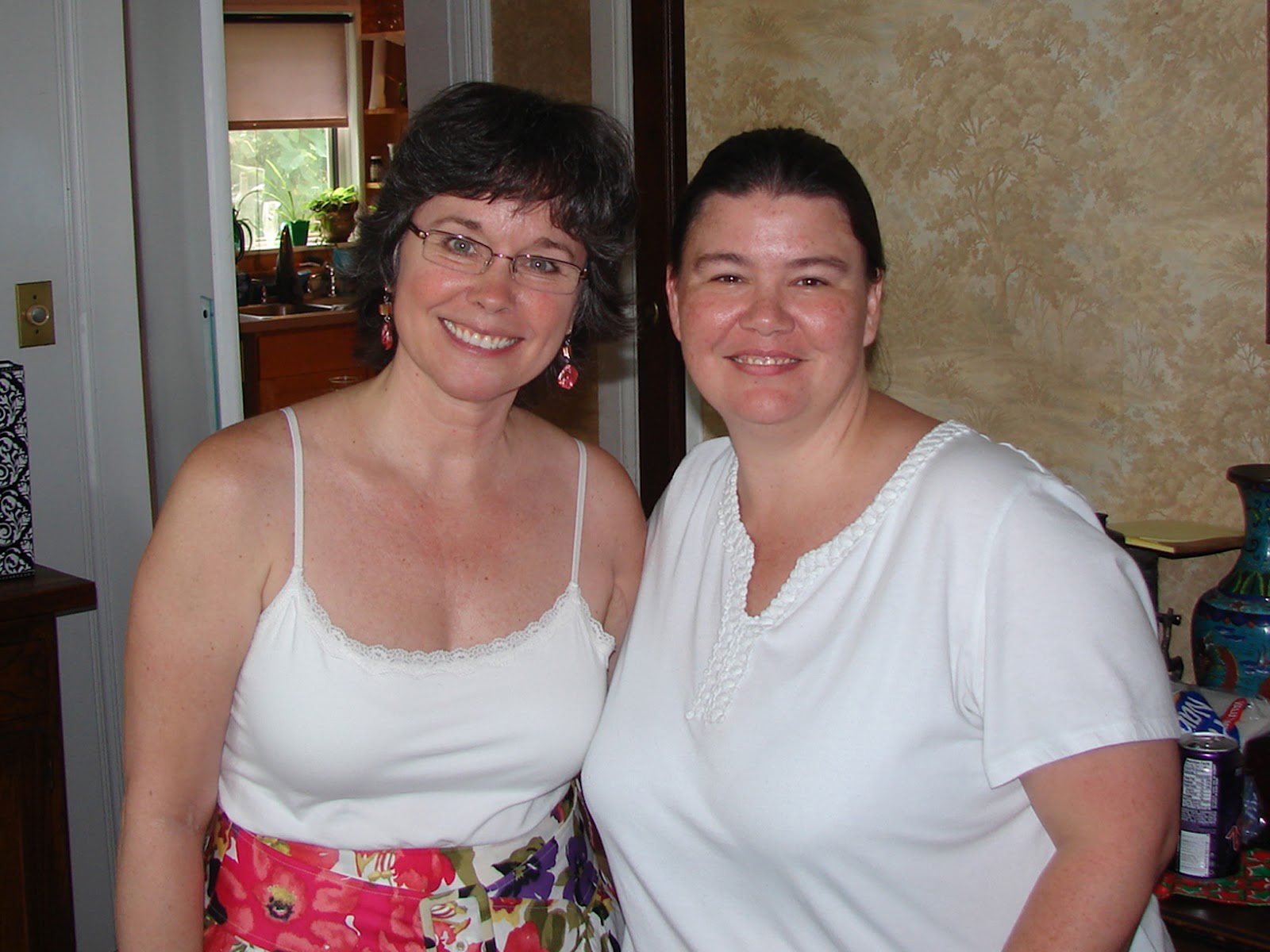
There were some new faces there this year, and I met two ladies that I really clicked with.  And here they are, Debbie Prim with me, below, and Lynn Weiler, with me, below below.  Oh, and Debbie has a blog that you should check out called Confused and Gassy.  What a hoot!


Of course, Jimmy and Christine Moore were there, and Jimmy read the introduction to his new book which will be released soon.


And I was happy to have my picture taken with Amy Dugan and Dana Carpender, who wrote most of The Fat Fast Cookbook, along with me, who wrote but four of the fifty recipes in that book.


Amy Dungan and me
Dana Carpender and me

These two ladies are so much fun and so sweet, and I am so happy that we get to spend time together, even if it is only once a year.  If you want to see some more of Dana's cookbooks, click here.  You can also visit her website, Hold the Toast.  Amy has her own blog, Healthy Low Carb Living

The food Saturday was fantastic, as usual, with the highlight for me being the low carb chocolate cookies, of which I ate WAY too many!  

The day started out with good weather, but around 2 pm, the storm hit and we all had to scurry to the shelter of the house and carport.  It was still great, and not as hot as last year.

A real thrill for me was getting to meet Dr. James Carlson.  I have read many of his blog posts and part of his book, Genocide: How Your Doctor's Dietary Advice Will Kill You.  I did not know he and his wife, Gloria, were going to be there until a few minutes before they arrived.  I was hoping to have a moment or so with Jim to ask questions, and I was formulating some in my mind.  I did get the chance to talk to him, and not just for a few minutes.  He was very outgoing and happy to discuss diet and health with anyone who would listen!  All together, we probably talked for over an hour.  He is going to be my go-to doc if I run into any problems involving weight, etc.  It turns out that he lives about an hour from me!  Yay!  I think he picked up at least two patients that day, although I am sure that was not his intention in coming.

Me, Dr. Jim Carlson and his lovely wife, Gloria

All in all, I had a wonderful time, and I can't wait to go again next year.  In fact, I am wondering if there is a way to get something like that going around my neck of the woods, which would be the Chicagoland area.  Is anyone interested?  We could do it at my house, which is about 40 miles southwest of Chicago.

Wednesday, May 29, 2013

THE VIRGIN DIET - DAY 1

Yesterday, I completed Day 1 of The Virgin Diet.  It went well for the following reasons:

  • I enjoyed the shakes I had for breakfast and lunch.  It was nice not to worry about what to eat for a change!
  • I was not starving all day like I have been lately, even though I have been eating high fat.
  • I had energy and did not feel sleepy in the middle of the day like I have been lately.
  • My blood sugar was 84 an hour and a half after eating.
  • I had normal elimination for a change.
  • I slept through the night for a change.
  • I woke up this morning at 6:30 feeling refreshed and ready to start my day, and I was not starving when I woke up.  Lately, I have been so hungry that I would feel real hunger pangs even in the middle of the night. 
  • I lost 0.6 pounds yesterday.  To get back to my goal weight, I need to lose 11.8 more pounds.
I normally eat like this:

135g fat (78%)
57g protein
28g carbs

But yesterday, I ate like this:

114g fat (57%)
102g protein
89g carbs

I had a shake for breakfast and lunch that was comprised of coconut milk, water, non-dairy protein powder, ground flax seed, raw kale, frozen blueberries and a few drops of Stevia.  All that made around 16 fluid oz. of shake and it took more than a few minutes to drink it!  The first one I made was tolerable, but the next one I found easy to drink and somewhat tasty.

JJ's plan is that you eat three meals per day.  The first one needs to be within one hour after rising, and the other two need to be 4-6 hours apart, with no snacks.  The last meal of the day should be no closer to bedtime than 2-3 hours.  Yesterday, I ate breakfast at 8 am, lunch at 2 pm and dinner at 7 pm.  For a change, I also did not feel like snacking after dinner.

Part of this process is making sure that you have good digestion by not diluting your stomach acid at meal times so that you can properly digest your food.  An hour before eating, I drink 16 oz. of water, then nothing while I am eating, then wait for an hour after eating to drink another 8 oz.  I like this better than trying to remember to drink water all day.

All in all, not a bad start.  In a few days, I will be traveling out of town to take care of a sick friend for the weekend, and I am a little concerned that I will need to be doing this while I am there.  But journaling here always helps to keep me on track, so I think I will do okay.

If you are interested in getting a short synopsis of how this plan works, you can listen to Jimmy Moore interviewing JJ Virgin by clicking here.

Saturday, July 21, 2012

MY FIRST ARTICLE AT CARBSMART.COM

Well, I've been keeping a little secret from my readers.  I didn't want to say anything, in case nothing came of it, but when I met Andrew DiMino at the Low Carb Meet & Greet this summer, he asked me if I would be interested in writing for his online magazine, CarbSmart.com.  I thought about it for a few days, wrote an article and emailed Andrew, saying, "The answer is 'yes' and here is an article for you to consider."  And guess what!  He liked it!  It went through a little editing with Dana Carpender and was published very late last night.


I am so tickled to be joining the ranks of Andrew DiMino, Dana Carpender, Amy Dungan, Jimmy Moore and others, in writing articles about the low carb movement and my personal journey in weight loss and improving health.

This is my article to the left, entitled "The Carbiest Generation." Here is a short excerpt:

When future generations look back upon today’s generation, what will they see?  What will set us apart in the timeline of human history?  What contributions have we made to humanity that will define us in a word or a phrase?  Some people in the Low Carb Movement think we will be known as “The First Modern Generation Where the Children Had a Shorter Life Span than Their Parents,” but that’s a little wordy.  I feel a better name would be “The Carbiest Generation,” because, when it comes down to a pretty important aspect of our humanity – our overall health and very existence — this encompasses all that has gone wrong.  Blame it on the food guidelines that have been handed down to us by the United States Department of Agriculture (USDA) and promoted by our government starting in 1977.  That’s when George McGovern took it upon himself to change the way America eats by vilifying saturated fat and cholesterol and glorifying carbohydrates.  In case you don’t remember what happened back then, or were not even born yet, this short video by Tom Naughton summarizes the dubious wisdom and eventual adoption of the tenets of The McGovern Report.  (Read the full article here.)

Sunday, July 15, 2012

NUTRITIONAL KETOSIS - WEEK 1 RESULTS

Last week at the Low Carb Meet & Greet, I spoke to Jimmy Moore about the new n=1 experiment he is doing.  It involves eating higher fat and lower protein than he usually eats, because there is the chance that eating too much protein is causing it to turn to glucose in his blood, and stopping his weight loss.  He is also testing his blood ketones with a specialized meter that is usually used by diabetics to check for ketoacidosis.  (Ketoacidosis is not to be confused with nutritional ketosis, which is the goal here.)  The meter can also be used to check for ketone bodies in the blood as a way to measure whether or not you have entered ketosis and are burning fat for fuel rather than sugar.

Since I've tried just about everything else, and still need to lose an additional 22 pounds of body fat, I decided to give it a go.  I ordered a ketone meter just like Jimmy's (which arrived yesterday) and the strips to use with it (which will arrive soon) and I started tracking my macronutrients again.  The last time I kept track of all of that was almost a year ago, so it was a little tough getting into the swing of that again.  I came up with a plan for how many grams of fat, protein and carbs to eat each day:

187 grams of fat (85% of total calories)
54 grams of protein (based on my height of 5'3")
20 grams of carbs (not net carbs)

I've been doing this now for 6 days, and so far, I am losing weight and inches for the first time in over a year.  Here are some of my charts:


In summary, in the past 6 days:
I lost 1/4" around my neck, 1-1/4" around my waist and 1/2" around my hips.
I lost 3.2 pounds on the scale (lost 3.8 pounds of body fat and gained 0.6 pounds of lean mass).
I went down 1.8 percentage points on my body fat.
I went down 0.021 points on my waist-to-hip ratio.

So I would say that this is working.  I'm encouraged to continue another week.  And for those who have asked what I am eating, click here to see my daily menus, and then you can click the page numbers at the bottom to see each individual day.  I probably won't continue to post these each week unless I drastically change something, because it's too time consuming and boring.

Here is the average of the six days that I tracked:

1950 calories
183.1g fat (84.5%)
54.2g protein (11.1%)
21.4g carbs (4.4%)

I came pretty close to the goal I set for myself that I shared at the beginning of this post.

The big question, obviously, is if this way of eating is sustainable.  As far as hunger goes, I think it is, because I'm not hungry.  In the past, when I would go on high carb, low fat diets, I would sometimes lose weight, but I starved all day, and I just could not keep it up.  So, hunger wise, I'm golden.

Another problem with it is whether or not I can keep up eating so little protein.  I have no problem eating all the extra fat, because that's fun.  Having very small portions of protein is a bit of a sacrifice for me.  Right now, I am eating about half the grams of protein that I am used to eating.  I feel a little deprived.

The only other factor I can think of is boredom.  I'm going to have to come up with some creative ideas for high fat, lower protein meals.  Of course, if my choice is to be bored or to be overweight, I'll choose boredom any day!

I will really be happy to start testing my blood ketones so I can see how my ketosis level factors in to all of this.  Looking to the future, if this works the way it is supposed to, it means at some point I will need to increase protein or carbs or both in order to stabilize my weight.  So, right now, it's possible that I could be eating a little more protein or carbs and still be losing weight.

Today started Week 2.  I'm feeling good.  I'm encouraged.  See you next week!

RELATED POSTS:

Saturday, July 14, 2012

THE BREAKFAST OF CHAMPIONS - EGGS AND FAT AND MORE FAT

I'll post more details tomorrow about what I've been eating this past week since returning from the Low Carb Meet & Greet last weekend, but, for now, I wanted to share what my typical breakfast/lunch looks like.  I call it my breakfast/lunch because, although it looks like breakfast, I usually eat it around lunch time, and today is no exception.

In an effort to reduce my protein and increase my fat, I'm having to really pile it on!  With a little inspiration from Jimmy Moore, here's the big, yummy and filling recipe:


I start by spreading 1 oz. of organic cream cheese on a sandwich plate.  I use my fingers for the spreading and then I lick my fingers.  I then cut 1 Tbs. of organic butter into little pieces and distribute them on top of the cream cheese.  I use a paring knife for the cutting and then I lick the knife.


In a small mixing bowl, I use a wire whip to whip up 2 Omega-3 eggs, plus one more yolk, 1/8 tsp. sea salt and 1/8 tsp. ground turmeric.  I do not lick the wire whip (salmonella).  I put the eggs into a small pan in which I have melted 1 Tbs. of unrefined, organic coconut oil.  I stir the eggs with a rubber spatula over medium heat until just set and still a little wet.


I put the cooked eggs on top of the cream cheese and butter on the plate, being sure to scrape any oil that is still in the pan onto the plate, which melts the cheese and butter, and then I lick the spatula.  The final touch is dotting the eggs with 1 Tbs. organic sour cream and then licking the spoon.  I even use a spoon to eat my eggs/fat/fat meal because I do not want to leave any of the fatty goodness behind on the plate.  Of course, I can't get it all, so I lick the plate when I am done.

 My goal for the day is to eat 187g of fat (85% of my total calories), 54g of protein and 20 grams of carbs.  Along with this meal, I try to get in some raw veggies to up my carbs.  That way, I am not eating the majority of my carbs at dinner.  This meal gets me started, and I run just fine on it until dinner time, rarely experiencing any hunger.  Here is the breakdown of this meal:

557 calories (not that I really care, but some people are interested in that number)
52.7g fat (85.2%)
18g protein (13%)
2.6g carbs (1.8%)

Monday, July 9, 2012

TESTING BLOOD KETONES WITH JIMMY MOORE

Recently, Jimmy Moore, in his Livin' La Vida Low-Carb Blog, shared that he started a new n=1 experiment that was inspired by his reading of the new book The Art and Science of Low Carbohydrate Performance (2012) by Stephen Phinney and Jeff Volek, who also authored The Art and Science of Low Carbohydrate Living (2011) and, along with Eric Westman, The New Atkins For a New You (2010).

In this newest book, the subject of blood ketone testing is explained in detail.  In the "olden days", we had to use urine testing strips for testing ketone levels, and the results were less than consistent.  Back in 2000, my husband, Bill, lost around 30 pounds eating very low carb but never turned a strip purple, which is supposed to show evidence of ketosis.  I, on the other hand, did not lose any weight, and my testing strips turned as dark a shade of purple as they could.

Today, there is a new over-the-counter system available to test blood ketone levels.  Although designed for diabetics, this system can easily be used by people like myself and any other non-diabetic who wants to get to the bottom of why they are not losing weight eating low carb.  Jimmy Moore explains here how he is testing his blood for evidence of ketone bodies with a handy dandy hand-held meter which is very similar to the blood glucose meters that you can buy in any pharmacy.  One drawback is that, although the meter is pretty cheap, the testing strips for ketone measuring are pricey at $5-$6 per strip, but I guess it would be worth it to achieve the results that you have coming to you!  Typically, one strip is used each day.  You can find the meter and the strips on Amazon.com here and here.

I bought my meter from Amazon, but I bought my strips here, because they were much cheaper.

Jimmy explains how it has become obvious to him, after testing his blood for ketone bodies, that although he has been diligently eating low carb all these years, he has probably been eating too much protein for his system.  And anyone who has been low carbing for any amount of time has heard that excess protein, beyond what the body needs, will be turned into glucose and will hamper ketosis.  Even a zero- or nearly-zero-carb diet will not produce weight loss if too much protein is being eaten.  I'll let Jimmy tell you the details of just what exactly he is eating now, but suffice to say his protein intake is less and his fat intake is more, along with his regular low carb.

Jimmy spent a few days visiting with Tom Naughton this past week, and Tom was able to witness first hand the new way Jimmy is eating and losing weight, and blogged about it here.  Tom bought one of the meters, too, and is hoping to shed those last couple of pounds himself.

Obviously, I have found this very interesting!  Anyone who has read this blog knows of my struggles to get rid of my remaining visceral fat.  Although I am thrilled that I have lost 17 pounds of body fat in the last three years of low carbing, currently, I am still carrying around an extra 20 pounds of body fat that I would love to get rid of, once and for all, and the idea that this might just be the answer has me, well, pretty excited!

Today, I tracked my grams of fat, protein and carbs for the first time since last summer.  Drs. Phinney and Volek advise that you should be eating between 0.6 and 1 gram of protein for each of your pounds of lean body weight.  With my goal of lean body weight at 99 pounds, I should be eating between 59 and 99 grams of protein per day.  In the past, I've tried 99 grams per day and more, but the results were bad, so this time, I will go to the low side and see how that works.  Today, I ate 160g of fat (84.7% of total calories), 47g of protein (11.1% of total calories) and 18g of total carbs (4.3% of total calories).  I was not hungry all day, eating mostly fat with a little bit of protein and carbs for breakfast and lunch, and a normal-ish dinner of salmon patties and salad.  I also did some interval training outside (6 intervals of slow walking interspersed with fast-as-I-could-go sprints) before it got too hot outside to bear.

I really want to buy the meter and the strips to see if I am in ketosis, but money is tight and I have not decided whether I need to spend the money yet.  If I start losing weight by just eating this new way, I may skip the meter all together.  But I love data, and I probably will not be able to resist forking over the cash to do at least 10 days worth of testing.

I started out this morning at 147.4 pounds on the scale, with a body fat percentage of 36.3%.  I wonder what I will weigh next week?  Golly, I hope this is the answer I have been looking for!

Sunday, July 8, 2012

2012 LOW CARB MEET & GREET

2nd Annual Low Carb Meet & Greet last year in 2011
Yesterday, I traveled four hours to the home of Dana Carpender for the 3rd Annual Low Carb Meet & Greet.  After my drive through the record-breaking 100+ degree weather, I found that the party had been moved indoors, and what a relief that was!  Even so, with fifty low carbers in Dana's house, it was still pretty warm, and I snagged the spot over the air conditioning vent more than once while I was there!

It was so fun to get to meet some of the movers and shakers of the low carb movement and get to ask questions about their views, their health and progress and the ways that their blogs, podcasts and websites are impacting the state of the health here in America and even around the world.  They are such a fun group and so giving of their time to effect change for the good of all of us, healthy and struggling alike.

Me with Dana Carpender and That Nice Boy She Married, aka Eric Schmitz
You will recognize Dana Carpender from her website Hold the Toast.  I added Dana to my blog roll last year and have learned so much about the low carb movement from her.  I did have the chance to have a long discussion with her yesterday, and got to sample some of her favorite low carb dishes, too!  What a neat thing to do to open her home each year to host a party like this.

Me with Jimmy Moore and his lovely wife, Christine
It almost seems silly to give Jimmy Moore any introduction at all, but in case you are new to low carbing, Jimmy is an American blogger and author who is best known for his Livin’ La Vida Low-Carb books and blog. He has appeared on numerous television and radio programs promoting a high-fat, moderate protein, low carb diet plan.  I had the honor of being a guest on his podcast in 2010 (which you can listen to here), as a result of being a "success story" in the newest Atkins book, The New Atkins For a New You, which was published that year.  Jimmy is a hoot and it was so fun to finally meet him face to face.

Dana Carpender, Gracie the Incidental Beagle and Jimmy Moore
If you follow his blog, you will know that he has started a new n=1 experiment involving nutritional ketosis, which you can read about here.  After losing almost two hundred pounds and then gaining a portion of it back, his struggles with trying to find "the magic bullet" that will take care of his weight problems in a permanent way have been well documented by Jimmy himself on his blog and in his podcasts.  I admire his transparency in this matter, and I have always tried to emulate that honesty here in my blog.  I must have done a good job of that, because my detractors seem to have memorized all of my failings! 

I think that everyone there wanted to hear a first hand account of how his latest experiment is going, and I was no exception!  Jimmy graciously took 15 or 20 minutes explaining to me what he is doing and how he has started losing weight again (yay!) as a result of tracking the ketone bodies in his blood with a specialized meter, similar to a blood glucose meter.  After hearing more about it, I will be getting The Art and Science of Low Carbohydrate Performance, and trying out this experiment for myself to see if I can whittle off those last pesky 10 pounds!  I am very anxiously awaiting Jimmy's next report of his progress.  Onward and downward, Jimmy!

Me with Amy Dungan
A new person on my radar is Amy Dungan, the author of the Healthy Low-Carb Living blog.  I had heard her name a few times, but just checked out her blog a few days ago.  I added her to my blog roll (look right and scroll down) and I'm very interested to start trying to keep up with her and her posts.  Like me, Amy has had her ups and downs with low carb living, and I admire her stick-to-itiveness and resolve to never give up.  We also got to talk one on one for at least a half of an hour, as she shared her journey with me and the hopes she has for her blog.  One fun thing - Amy looks so much like my daughter, Emily, and I could not resist telling her that and showing her Emily's senior portrait.  Not only did Amy say there was a resemblance, but showed me photos of herself at a younger age to show how much she really did look like my daughter!  (Amy's husband John was there, too, but was absent at picture-taking time.)

Andrew DiMino
As the party was winding down and most of the folks had departed for home or hotel, several of us lingered in the living room and chatted.  There was a nice gentleman sitting in the chair next to me, and presently, he extended his hand to me and said, "I don't think we've met.  I'm Andrew.  And how do I know you?"  I was so happy that I could at least say I was in the new Atkins book!  And, lo and behold, he was none other than Andrew DiMino, president, founder and publisher of Carbsmart.com.  He told me about how he started in the business, and how he has recently made the decision to discontinue the online store at CarbSmart and focus on the online magazine.  We also got to share before and after photos of each other, which was fun.  Of course, I had to show him my morphing weight loss video on youtube.

Andrew was very patient to listen to my woes concerning my struggles with my weight and the attacks I came under writing this blog, and encouraged me to press on.  Thanks for that, Andrew!  Here is a little funny thing - earlier that day, I needed to test my camera, so I pointed it at Andrew (whom I had not yet met) and asked if I could snap his picture.  And then I ended up having a great conversation with him a few hours later.

I was wondering what was going to offered in the way of cold drinks at the party.  I have been off of diet soda for a while (although, I must admit I have one rarely as a special treat), so I was thinking I would be drinking water all day.  I was so pleased to find out that Zevia had sponsored the party, and provided a ton of free cans of their all natural soda.  I sampled the grape, orange and dew flavors, and I really liked them!  Learn more about Zevia here, and where to purchase it in your area. 

All in all, it was a great time, and was surely worth the trip!  I'm sure I will attend next year, if Dana and Eric decide to continue this tradition, and maybe I can find a friend to bring.  Maybe my husband!


In closing, I want to share this photo I took of Amy and Jimmy.  Amy found these shirts at Walmart and could not resist buying a couple for herself and Jimmy, and, of course, they had to model them and have their picture taken!  Both Jimmy and Amy have their detractors,  but have managed to keep a positive and upbeat spirit about the whole thing.  Obviously! 


Sunday, October 31, 2010

LOW CARB BRUNCH

I just finished having brunch with my husband and my father at my home. Dad was very impressed with the spread - all low carb and so delicious! It was so nice - house all clean and sparkly, beautiful weather and smooth jazz on the sound system.

Here is the menu, all of it organic, free range, no hormones or antibiotics, Omega-3 eggs, nitrate-free, etc.

Cheese Baked Eggs
Baby Bella Mushrooms sauteed in lots of butter
Bacon
Pumpkin Flax Bread with Lime Frosting
Coffee for the men and brewed loose leaf tea for me

Bill and I usually don't have that much in the morning (it was a big meal!), but we had company, and now I feel like I've had my treat for the week! I will have a smaller dinner to make up for it.

It's so nice to be able to offer someone a really good, low carb meal, and to show them how satisfying it can be.

And for entertainment, we listened to my interview with Jimmy Moore, which Dad had not heard yet.  He said it was a good interview, but all he kept thinking was, "There's gotta be some way you can make money off of this!"

Saturday, October 30, 2010

BIG FAT FIASCO

This from Jimmy Moore of the Livin' La Vida Low-Carb Show:

Tom Naughton, whose FAT HEAD documentary is one of the most entertaining and informative films on healthy low-carb living ever made, had gone on the speaking circuit with a fabulous speech called “Big Fat Fiasco.” This is well worth your time to watch from start to finish because Tom infuses his trademark humor and ability to make the complex understandable. You’re gonna enjoy this!

And from me, Rebecca - This is one of the best explanations of why the "high cholesterol causes heart disease" theory is false and is doing nothing but killing people. By the time it was over, I was almost to the point of tears because it was so true and moving. Everyone needs to know this!


Friday, October 8, 2010

JACKIE EBERSTEIN DEBUNKS THE CURRENT CROP OF ATKINS MYTHS

This from Jimmy Moore and The Livin' La Vida Low-Carb Show:


The Atkins diet enjoys a rather odd position in the world of health and nutrition–you either love it or you hate it! There are very few people who kinda like it or kinda dislike it. And I suppose this has a lot to do with the misconceptions and myths that pervade about it in our culture. But the fact is most of these perceptions about the Atkins low-carb lifestyle are easily combatted with the facts that have been borne out by the experience of real life low-carbers and the science that backs them up. Today’s podcast interview guest is arguably the most knowledgeable expert on the Atkins diet today after working directly with the late, great Dr. Robert C. Atkins for nearly three decades.

 In Episode 389 of “The Livin’ La Vida Low-Carb Show with Jimmy Moore,” we welcome back to the show registered nurse Jackie Eberstein from Controlled Carbohydrate Nutrition and co-author (with Dr. Mary C. Vernon) of Atkins’ Diabetes Revolution. It’s been a couple of years since we’ve had Jackie with us on the podcast (listen to my June 2008 interview with her–listen to Part 1 and Part 2) and she’s been a regular keynote speaker on The Annual Low-Carb Cruise the past few years. But I wanted to bring her back on the podcast to address many of the lingering myths about the Atkins low-carb diet that still pervade in our culture. Listen to Jackie share what she thinks Dr. Atkins would say about The New Atkins For A New You, her attempts to correct the ongoing Atkins myths over the years, her typical low-carb menus, why she has to personally stay very low-carb, why reactive hypoglycemia is not caused by low-carb eating, the impact of sweeteners on hypoglycemia, whether you should count calories on the Atkins diet, why “calories in, calories out” is totally bogus, why Atkins won’t raise your lipids to unhealthy levels, why high triglycerides are not caused by fat but by insulin (stoked by carbohydrate consumption), which is more important–LDL particle number or particle size, why red meat is not the great harm it is purported to be in studies, why pigs are better animal studies than rats and worms, why there are no kidney damage concerns for people eating the Atkins diet (because it’s NOT a high-protein diet, it’s a moderate protein diet), why getting adequate protein is so vital to your health, her reaction to what the 2010 Dietary Guidelines will include and whether low-carb will even be considered, whether the Paleolithic diet jives with the Atkins diet, why free-range, organic meats are best, her response to the “one golden shot” theory that you can only lose weight on Atkins low-carb once, why there is a lot we don’t understand fully about fat cells, why cutting fat while consuming a low-carb diet is not wise, why the scale is not an accurate measuring stick for your weight loss progress, why regular exercise is an important companion tool with low-carb living, why some people are continually tired on the Atkins diet and what they can do to overcome it, the research links she provides on her web site, why Atkins does not lead to osteoporosis, why low-carb is not lacking in nutrition because you need to take supplements while on it, how consuming carbohydrates actually depletes nutrition from your body, and what she wishes more people would understand about the Atkins diet. For anyone who thinks low-carb is harmful to some aspect of their health, then this interview with Jackie Eberstein is one you don’t want to miss!

To listen to the interview, right click here.

Tuesday, October 5, 2010

11-YEAR OLD BIRKE BAEHR SPEAKS ON REAL FOOD

i just found this youtube clip on Jimmy Moore's blog. This young kid sure has his head on straight when it comes the to food he puts in his body!

MY INTERVIEW WITH JIMMY MOORE ON THE LIVIN' LA VIDA LOW-CARB SHOW

In Episode 404 of “The Livin’ La Vida Low-Carb Show with Jimmy Moore,” we hear from Atkins weight loss success story Rebecca Latham who was featured on pages 114-115 of the bestselling The New Atkins For A New You book. She shares all about her journey these days at her “My Low-Carb Road To Better Health” blog with all the ups, downs, and in-betweens that have happened to her over the years. Hear Rebecca talk about how she has always felt fat even when she was at a normal weight, the various diets she has been on over the years, how she found the Atkins diet for the first time in 2000, how her husband was positively impacted by following Atkins until he stopped doing the plan, her fateful encounter with Colette Heimowitz from Atkins Nutritionals, the hormonal challenges she faces that makes building muscle and burning body fat difficult, the various setbacks she has experienced in her low-carb lifestyle, the heavy influence of Mark Sisson’s work (The Primal Blueprint is “like Atkins on steroids”), the necessary tweaks she needed to make to make her low-carb plan work for her, why the scale is not a reliable indicator of your low-carb progress, her frustration with finding the right body composition, her recommendation for people wanting to eat a more clean low-carb diet, the health issues her husband has been dealing with which have required him to get back on Atkins again, the change in body perception she has experienced since losing weight, the supplements she takes on her Atkins lifestyle, the genetic predisposition for ALS and how her supplements are helping her with this, her foray into intermittent fasting, her sample low-carb menus, her use of thyroid medication and how it has helped her, her “My Body Is Not A Piggy Bank: Do Calories Matter?” thread on the Atkins forum, and the ramifications of eating too much fat. You’ll quickly realize how and why Rebecca is such an ardent defender of the low-carb lifestyle and has become quite knowledgable of how it works over the past decade.

Listen to the interview by right clicking here.  There are two interviews on the podcast, and this one starts at 19:47 on the counter, so you can fast forward to that number if you like.

Tuesday, June 22, 2010

THE RISE OF FAKE FOOD AND MISINFORMATION

(This is an excerpt from the book The Liberation Diet by Kevin Brown, who was interviewed by Jimmy Moore on the post before this one.)

What do candles, soap and buttermilk biscuits have in common? Industrial waste products.

It all started back in 1837 when William Proctor and his brother-in-law James Gamble combined their candle and soap making businesses to make it easier to obtain the beef tallow and lard necessary for their products. Tallow and lard were hard to come by because of fierce competition and price fixing. Irritated at having to pay high prices for their raw ingredients, which cut into their profit margin, Proctor and Gamble began to search for an alternative to tallow and lard. The boys invested in cottonseed mills. Before cotton can be incorporated into a T-shirt or Q-tip, the seeds are removed and discarded as industrial waste. Proctor and Gamble discovered that oil could be extracted from these seeds. Unfortunately, the oil was unstable and not very useful for their products, but, in 1907, with the help of the German chemist E.C. Kayser, Proctor and Gamble developed the science of hydrogenation. They took the cottonseed oil and added hydrogen molecules combined with extreme heat and pressure creating a solid, stable form of cottonseed oil which happened to look a lot like lard.


This new product worked fairly well for soap and candles, but the candle business was dwindling due to the invention of electricity. Candles were used for light back in those days, not for fragrance or decoration, so Proctor and Gamble had to find some other use for all the solid cottonseed oil they were producing. The conversation went something like this, “Well, it looks like lard and acts like lard. Say, why don’t we stick it in a can and call it a food?!” So they stuck the stuff in a can, called it Crisco, short for “crystallized cottonseed oil,” and put it on the market in 1911 as an alternative to lard.

But how do you convince housewives that an industrial waste product is safe to eat?

Proctor and Gamble launched the most ingenious advertising campaign ever. First, they wiped out the competition, lard and butter, with the statement “more economical than butter and healthier than animal fats.” The boys didn’t bother to do any studies comparing the health benefits of Crisco to animal fats; they just said what they needed to say to sell their product. Second, they published a cookbook with 615 recipes all calling for Crisco. The cookbook taught housewives how to use this new fangled fat and appealed to their sense of pride with pictures of young women teaching their mothers and grandmothers to use Crisco instead of animal fats. Crisco was advertised in the cookbook as cleaner than and more easily digestible than animal fats and children growing up on Crisco would be well behaved and intelligent. Crisco was the choice for any enlightened, modern mother who cared about the cleanliness of her home, her standing in the community and the behavior and health of her children. Jewish housewives embraced Crisco with open arms because it behaved like butter but could be eaten with meat and was marketed as such. Another assumed benefit
of Crisco was its 2 year shelf life which ensured that consumers would be able to use the entire can before it went bad. Crisco became a household staple and the first truly fake food.

The formula was brilliant; take an industrial waste product, put it in a can, and market it as a health food.
Crisco became the first in a long line of fake foods that have replaced real food in the American diet. Following close on the heels of Crisco is soy lecithin, the industrial waste product of soybean oil. Lecithin, or phosphatidylcholine, is a component of all cell membranes allowing both water soluble and fat soluble substances to pass through. Oil and water don’t mix, but if you add an egg yolk, they can be combined. Lecithin is just like the egg yolk. Without it, water soluble substances such as vitamin C would not be able to enter cells. Egg yolk happens to be one of the best sources of lecithin in the diet. You may remember that lecithin was a very popular health supplement in the 1970s.

Soy lecithin is the sludge left over from the processing of soybean oil. Kaayla T. Daniel describes this sludge in her book, The Whole Soy Story, as follows. “It is a waste product containing residues of solvents and pesticides and has a consistency ranging from a gummy fluid to a plastic solid. The color of lecithin ranges from a dirty tan to reddish brown. Manufacturers therefore subject lecithin to a bleaching process to turn it into a more appealing light yellow hue. The hexane extraction process commonly used in soybean oil manufacture today yields less lecithin than the older ethanol-benzol process, but produces a more marketable lecithin with better color, reduced odor and less bitter flavor.” Soybean oil is the most common vegetable oil used today and manufacturers need a cheap way to get rid of the industrial waste left behind. In the 1930’s, manufacturers hired scientists to invent ways to use the sludge left over from soybean oil. The scientists discovered over 1000 uses for this industrial waste product and that is why you will see soy lecithin in just about everything from food to cosmetics. Another industrial waste product that ended up in our food supply is fluoride. Hydrofluorosilicic acid is the industrial waste product from the manufacturing of phosphate fertilizers and aluminum and is considered hazardous. It is barreled up and sold across America to communities who add it to their water supply to “prevent tooth decay.” Before it was put into our water supply, it was blown out of smokestacks and dumped in rivers resulting in dead fish and deformed cows. But claiming a health advantage (fewer cavities) gave manufacturers a way to make money “dumping” their waste. Normally, manufacturers have to pay to get rid of industrial waste. They hit the jackpot.

Even if you live in a community that does not fluoridate the water, you may get more fluoride than you need from processed food. Chicken nuggets, tea, soda, cereal, juice and infant formula are just some of the processed foods made with fluoridated water. Fluoride disrupts thyroid hormones leading to hypothyroidism, a condition that contributes to obesity. Over the past 100 years, we have turned industrial waste into food and created fake forms of real food. We have fake butter (margarine), fake whipped cream (Cool Whip), fake eggs (Egg Beaters), fake cheese (Velveeta) and fake bread (Wonder Bread). The only thing that’s a “wonder” about Wonder Bread is that it’s allowed to be called bread. All of these products have been advertised as healthy alternatives to the real thing even though they all leave out life giving nutrients. They are cheap, easy to make in mass quantities and provide a higher profit margin for food manufacturers. Eating is no longer about health and nourishment; it’s all about the bottom line.

Can you guess what this food product is?

WATER, CORN SYRUP, HYDROGENATED VEGETABLE OIL (COCONUT AND PALM KERNEL OILS), HIGH FRUCTOSE CORN SYRUP, LESS THAN 2% OF SODIUM CASEINATE (FROM MILK), NATURAL AND ARTIFICIAL FLAVOR, XANTHAN AND GUAR GUMS, POLYSORBATE 60, SORBITAN MONOSTEARATE, BETA CAROTENE (COLOR).

No, it’s not transmission fluid, but it is a knock off of a food containing heavy cream, sugar and vanilla extract. That’s right, it’s Cool Whip; a food designed to replace whipped cream yet it doesn’t even contain cream.

How does fake food get promoted over real food?

Crisco turned out to contain harmful trans fats, but Proctor and Gamble didn’t know that when they marketed it as a replacement for lard. Food manufacturers realized that Crisco was cheaper to buy than butter or lard and it had the added benefit of extending the shelf life of any food made with it. From the food company perspective, Crisco and its cousin margarine were money makers so no one bothered to consider the health implications. After all, the number one concern of every business is the bottom line and most companies will do whatever it takes to stay in the black, including carrying out their own “scientific” studies designed to prove the health benefits of their fake foods.

In the 1950s, a theory popped up claiming that saturated fats were unhealthy. This was a godsend for the food industry because it provided a legitimate reason to use Crisco and margarine over lard and butter. Now the food companies could increase their bottom lines under the guise of improving the health of consumers.

The food manufacturers latched on to the anti-saturated fat theory and propelled it forward unaware of the fact that they were actually doing more harm than good.

To buy The Liberation Diet, right click here.

PERSONAL TRAINER KEVIN BROWN OFFERS LOW-CARB ‘LIBERATION DIET"

I just listened to a great Jimmy Moore interview with Kevin Brown.  Jimmy shares his conversation with personal trainer and Liberation Diet author Kevin Brown. Listen in as Kevin describes the speedy success he’s had with his clients ever since he decided to do the “opposite of what all the nutrition experts say.” Today’s conversation ranges from the influence of the great Dr. Weston A. Price to the roots of the American Heart Association (and its founder’s opposition to the cholesterol theory of heart disease) and the three foods Abraham served to God when he came to dinner (hint: there was no Pepsi, margarine or Tofurkey at that momentous meal)!


In Episode 369 of “The Livin’ La Vida Low-Carb Show with Jimmy Moore,” we are pleased to welcome personal trainer and low-carb nutritional health expert Kevin Brown, author of The Liberation Diet: Setting America Free from the Bondage of Health Misinformation! He is providing quality health information to both his readers at LiberationWellness.com as well as the listeners at his own podcast show called “Liberation Wellness Hour Radio Show.” Listen to Kevin talk about his years of frustration trying to help his fitness clients lose weight, why he started doing the exact opposite of everything he was told was healthy and saw incredible improvements in his clients, why low-carb diets have been singled out as being bad for you, what he thinks the breaking point will be about the truth regarding nutrition, the misinformation that is out there about diet and health, why high saturated fat intake is healthy for you, why real food has become so demonized, what would happen if everyone suddenly started eating real food, the importance of taking certainly vitamins regularly and the influence of the work of Weston A. Price, the answer to childhood obesity (which isn’t necessarily what First Lady Michelle Obama is promoting), why food and drug companies are ruining the health of Americans through their heavy financial influence, the influence of his faith in God on the work he is doing promoting health, and the story of Genesis 18 as evidence why we should be eating more saturated fat.

Right click here to listen to the interview.

Saturday, June 12, 2010

ADAM KOSLOFF - WHY LOW CARB DIETS WORK

When science journalist Gary Taubes released his magnum opus Good Calories Bad Calories in September 2007, it was designed to reach the sophisticated medical professionals who wanted the scientific history of nutritional therapies with voluminous references (comprising 150 pages of this 600-page book!). But the average consumer took one look at Taubes’ book and it made their head spin. Sadly, the information contained in this fantastic book was overlooked by the patients who could stand to benefit from the information as a result and it begged the question–when will someone come up with a simplified version that the average Joe and Jane can understand (actually, there is a new book coming from Gary Taubes in early 2011 that will be aimed at the consumer–we’ll be interviewing him about that when it releases)? Today’s podcast interview guest read Gary’s book and turned much of what he read about into a neatly-packaged web site.

In Episode 355 of “The Livin’ La Vida Low-Carb Show with Jimmy Moore,” we hear from Yale-educated web writer Adam Kosloff who created his Taubes-inspired web site at Why-Low-Carb-Diets-Work.com that is a great destination point for anyone who would never read Good Calories Bad Calories but desperately needs to be exposed to the low-carb message. Hear Adam talk about the influence of Taubes’ book on his thinking about nutrition, how Taubes reacted to his web site, the ease of use of the web site, his experience writing 20,000+ columns online, why the thesis that obesity is a disease of fat accumulation is the most important issue in the low-carb community, how “eat less, exercise more” had made us worse, what the “good carbs” are, why the one-size-fits-all diet is a weird concept, speculation regarding the diet connection to autism and food allergies, the funding for low-carb studies, why nobody is talking about the diet/health connection to the healthcare and economy issues, why the Food Pyramid needs to be changed before healthcare can truly be reformed, the Kosloff Conjecture about why we continue to do the same failed approach, why it’s important to acknowledge the line of thinking and engage in conversation of those whose thinking runs counter to yours, why it’s next to impossible for people like Dr. Dean Ornish to change their mind about diet and health, the constructive energy needed to move the message forward, his dream of a low-carb “The Biggest Loser” show without exercise and lots of saturated fat-laden meats, the influence of using YouTube to educate people about the low-carb ideas, and what his ideal nutritional world would look like. Adam is a deep thinker and a dreamer which you’ll sense the entire time he shares his answers during this interview.

(Right click here to listen to the interview.)

From Rebecca:

I was so impressed when I read Adam's website, Why Low Carb Diets Work, that I started a discussion thread on the Atkins Forum, called "My Body is Not a Piggy Bank! (Do Calories Matter?)" to share his ideas with the Atkins Community.  If you are interested in reading that, right click here.

Thursday, June 10, 2010

MELISSA DIANE SMITH GOES AGAINST THE GRAIN

We often hear the media and so-called health “experts” talk about the NEED to consume what they describe as “healthy whole grains.” They say that sugar and refined carbohydrates are certainly unhealthy for you, but you really need to add in whole grains to your diet. But what if the truth is that grains are just as harmful to your weight and health as sugary, carby foods? That’s exactly what today’s podcast interview guest is attempting to educate people about who deal with unexplained weight gain and decline in their health despite eating the “right” diet they’ve been told is good for them.


In Episode 356 of “The Livin’ La Vida Low-Carb Show with Jimmy Moore,” we hear from nutritionist Melissa Diane Smith, author of the book Going Against the Grain: How Reducing and Avoiding Grains Can Revitalize Your Health, who explains why whole grains need to be avoided and not encouraged as is commonplace in modern society. Hear Melissa discuss how her work at a popular health spa where she ate the recommended diet made her get fat and sick, what’s wrong with consuming grains, how grains became such a major part of the American diet, why we DON’T need to be consuming grains as is often promoted by health professionals, the anti-nutrient properties of grain products, delayed food allergies brought on by grains, the addictive nature of grains on the body, the harmfulness of genetically-modified foods (especially corn) and why they’re hard to identify, the grain-related sensitivities, why a gluten sensitivity doesn’t necessarily mean you have Celiac disease, the “Against The Grain” dietary guidelines compared with what the USDA is recommending, the challenges of eliminating grains from your diet and what you can do about it, why it’s important to replace whole grains with low-carb vegetables, how to purchase non-grain foods at the grocery store, why eating out grain-free isn’t such a big deal nowadays, how a vegetarian can give up grains (most are “grain”-arians!), the supplements that augment a grain-free diet, and why even kids should give up grains. If you think you need to consume whole grains in your diet, then you need to listen to my interview with Melissa Diane Smith.  Right click here to listen.

From me:

Since starting Atkins in March 2009, I have not eaten grains.  At first, it was because grains are not allowed in the beginning phases of Atkins, but, after finding out some of the things I have about grains, and how human beings are not adapted to eating them, I'm never going back.

I really don't miss the grains.  I have heard some people say that they could never give up their bread, but this is a non-issue for me.  About four months ago, I was in a restaurant, and everyone was going on and on about how good the bread was.  These were white, Italian-type dinner rolls, crunchy on the outside, and warm and soft on the inside.  So I had a few bites.  I have to honestly say that I was underwhelmed, and I did not finish it.  Even the butter I put on it did not make it desirable to me.  Next time, I'll give it a pass.

I was in Whole Foods Market the other day, and they had a tray with little chunks of a coarse bread made with lots of seeds.  I sampled it.  Wow!  It was great!  And so is chocolate cake, but I'm not eating that with any regularity, either!

When I am at someone's home, and I am offered a dessert made with flour and sugar, I sometimes partake.  I went to a wedding the other day, and I had a piece of wedding cake.  But there is no way that I am going to make flour, or sugar, for that matter, a regular part of my diet.  If I stay away from it 99.9% of the time, I guess I'm doing okay!

Before Atkins, I did eat steel cut oatmeal almost every morning for breakfast.  I loved it, and I'll miss it.  But I'm still not going back!

Although I think Melissa Diane Smith may be preaching to the choir on this subject, I just ordered her book from the library.  I'm sure I will learn a lot!

Tuesday, June 8, 2010

T.S. WILEY ON WHY LACK OF SLEEP WILL MAKE YOU FAT


In this episode of The Livin' La Vida Low-Carb Show, Jimmy Moore speaks with T.S. Wiley, creator of the Wiley Protocol and author of Lights Out: Sleep, Sugar, and Survival and Sex, Lies and Menopause.  Listen in as they discuss the effects of artificial light and bad sleep habits on health and weight, hormone replacement therapy, the importance of maintaining proper melatonin levels, her friendship with the late great Dr. Robert C. Atkins and much more.  Right click here to listen to the interview.


I read Lights Out last summer, and was very impressed with it.  I have recently started trying to go to bed earlier - in bed reading by 9 and lights out by 10 - based on the research I read in this book.  I highly recommend the book, but in the absence of that, this interview will give you a good overview of the contents of the book.

One very interesting part of the interview is where T.S. talks about an experiment done on young men that showed differences in weight and insulin levels based on how much sleep - in the dark - they were getting each day.  Fascinating stuff!