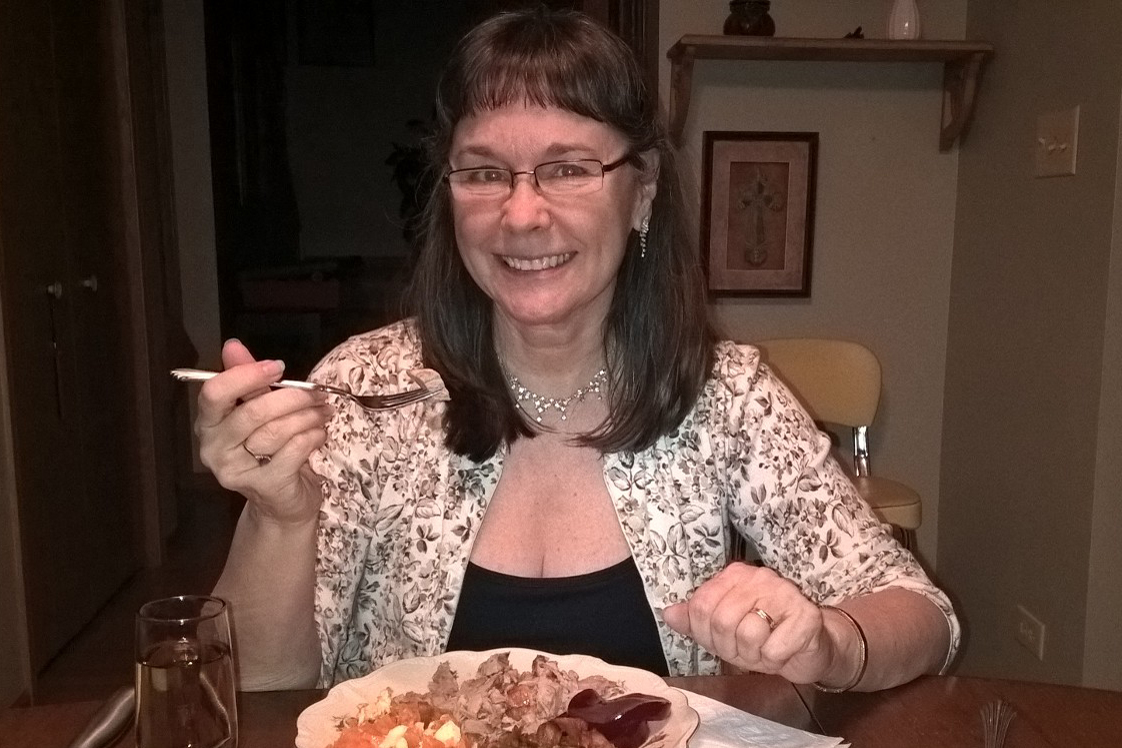
A few days ago, I started a closed Facebook group to give support to individuals who want to try the fasting protocol that I designed back in January 2016.
This blog will continue as always, but you can also find me on a daily basis on Facebook.
Showing posts with label Nutritional Ketosis. Show all posts
Thursday, July 7, 2016
Tuesday, April 5, 2016
FINAL RESULTS - 2016 WEIGHT LOSS AND BLOOD GLUCOSE CHALLENGE
![]() |
| Christmas Eve 2015 |
THE WAY I WILL EAT
One thing is for certain, and that is that I will continue to eat a ketogenic diet - high fat, moderate protein and very low carb. This really seems like the only way to keep on track. In the past, every time I have tried to increase carbs, I have gained weight. I really don't want to do that this time. More about exactly how I will proceed from here at the end of this post...
MY HbA1c TEST RESULTS
My test gave me a result of 5.2%, which is equivalent to an average blood glucose of 103 mg/dl. This is an improvement over my last test, but I would be lying if I did not say how extremely disappointed I am. What this means is that although my fasting blood glucose has come down into very good levels, my non-fasting blood glucose levels are still elevated. As much as I hate the idea, I am going to have to start testing my postprandial (after meals) blood glucose to see what is causing this problem. If my average is 103, that means that my post-meal readings must still be in diabetic ranges, possibly in the 120s and higher.
But, wait a minute! It is very hard for me to believe that my average BG is this high when I have been doing all this fasting. I went to the interwebs and found many articles that show the inaccuracy of the HgA1c test. This article by Chris Kresser is a good example and is very easy to understand. In short, Dr. Kresser believes that home monitoring before and after meals is a much better indicator of average blood glucose than the HbA1c test. He found that his patients who had stellar BG readings before and after meals at home would test artificially high on a standard A1c test. In the article, he mentions that people with anemia and/or iron-deficiency have incorrect results with the test. I have been anemic and/or iron deficient since childhood, so a standard home test for BG will be accurate when an HbA1c test may not. We'll get to the bottom of this!
Over this next week, I am going to check my BG at home nine times per day and find out what my true average is. I will check fasting when I get up in the morning, one hour after starting to eat breakfast, two hours after starting to eat breakfast, then right before starting to eat lunch, then one and two hours after that, and the same for dinner. The average of these nine readings should be very close to a true average. I'm very sure that my result will not show that I have an average BG of 103 mg/dl. I started doing this this morning, and so far my average over the three readings was 87 mg/dl. When this week is over, I will post my results.
The chart below is the final chart that shows my fasting blood glucose test results. The grey lines are my long term goals. The blue lines are my actual results. The orange lines are my 7-day averages. As you can see, I did make progress toward normalizing my FBG.
MY OFFICIAL BEFORE AND AFTER PHOTOS
Although I have posted a few casual photos in this past three months, I wanted to wait until the challenge to post my official before and after photos, so here they are:
As I always do when I take these type of photos, I took special care to stand normally, neither pushing out my stomach in the before photos nor sucking it in in the after photos. I also crop the photos so that they are the same size and can be compared side by side. Also, if you click on the photo above, you will be able to see that I have been left with loose skin. I hope you will not judge me too harshly for this, remembering that I am over 60 years old, and that is part of the reason why. I remember my father telling me that it would be better to be somewhat overweight in order to have tighter skin and therefor a younger appearance, but I would much rather look a little bit older and have a proper body size for my height!
Share:
Print Page
Hypoglycemia (Low Blood Glucose)
Hypoglycemia is a condition characterized by abnormally low blood glucose (blood sugar) levels, usually less than 70 mg/dl. However, it is important to talk to your health care provider about your individual blood glucose targets, and what level is too low for you.Hypoglycemia may also be referred to as an insulin reaction, or insulin shock.
Hypoglycemic symptoms are important clues that you have low blood glucose. Each person's reaction to hypoglycemia is different, so it's important that you learn your own signs and symptoms when your blood glucose is low.
The only sure way to know whether you are experiencing hypoglycemia is to check your blood glucose, if possible. If you are experiencing symptoms and you are unable to check your blood glucose for any reason, treat the hypoglycemia. Severe hypoglycemia has the potential to cause accidents, injuries, coma, and death.
Signs and Symptoms of Hypoglycemia (happen quickly)
- Shakiness
- Nervousness or anxiety
- Sweating, chills and clamminess
- Irritability or impatience
- Confusion, including delirium
- Rapid/fast heartbeat
- Lightheadedness or dizziness
- Hunger and nausea
- Sleepiness
- Blurred/impaired vision
- Tingling or numbness in the lips or tongue
- Headaches
- Weakness or fatigue
- Anger, stubbornness, or sadness
- Lack of coordination
- Nightmares or crying out during sleep
- Seizures
- Unconsciousness
As I always do when I take these kind of photos, I take special care to stand normally, neither pushing my stomach out in the before photo, nor sucking it in in the after photo. I also crop them in such a way so that they are equal in actual size and a true comparison can be seen.
I had a bad incision during my c-section in 1977, and my stomach muscles were cut in such a way that I will never really be able to use them to hold my stomach in. Because of that, I will probably always have a little bit of a "pooch" no matter how slim I am, but I can live with that. Some tummy-control undies go a long way to giving me the impression of a flat stomach. By the way, I am not wearing anything like that in either of these photos. I am wearing regular, non-slimming leggings.
MY BODY MEASUREMENTS
Another thing that I have been doing in the background during the challenge is tracking my body measurements. Here are the results for those:
NECK
12 3/8" - 11 3/4"
LOST 5/8"
BUST
36 3/4" - 35"
LOST 1 3/4"
WAIST
33 3/4" - 29"
LOST 4 3/4"
BELLY
41 1/2" - 37 1/8"
LOST 4 3/8"
HIPS
41 1/4" - 38 1/4"
LOST 3"
THIGH
22 7/8" - 21 1/4"
LOST 1 5/8"
CALF
14 3/8" - 13 5/8"
LOST 3/4"
TOTAL INCHES LOST - 19 1/4"
When I do the math for the total inches lost, I count each measurement as one unit with the exception of my thighs and calves, which I count as two units each. Because I have two of each of those. That might not be the right way to do it, but it is the way I do it.
SCALE WEIGHT AND BODY COMPOSITION
Before I talk about my weight loss, I want to explain how I determine my body fat and lean body mass percentages.
In the past few years, I have had DEXA scans and Bod Pod testing done to determine my body composition. These are very accurate, but are expensive, usually costing around $100, depending where you get it done.
Several years ago, I found an online calculator that is used by the US Navy and is based on neck, waist and hip measurements. I tried it out and found that the results, at least for me, were so similar to the expensive tests that I decided to start using the free online calculator to get an estimate of my body composition. In my experience, I have found the free results to be within a few tenths of a percentage point of the other tests. For my purposes, this is close enough.
My goal for the past several years has been to reach my goal of 136 pounds with 30% body fat. When trying to lose weight, the goal should be to lose body fat and not lean mass. So knowing what your body composition is starting and ending is very useful. Here are the results for those:
January 1, 2016
60.1 pounds of body fat - 39%
93.9 pounds of lean body mass - 61%
154 pounds of total scale weight
April 1, 2016
41.7 pounds of body fat - 30.3%
95.9 pounds of lean body mass - 69.7%
137.6 pounds of total scale weight
LOST 18.4 POUNDS OF BODY FAT
GAINED 2 POUNDS OF LEAN BODY MASS
The way I see it, I have come close enough to my weight loss goals to declare this part of the challenge a victory. Technically, I still need to lose 0.9 pounds of body fat and I am actually over my goal for lean body mass by 0.7 pounds.
Because my lean body mass is over my goal, I need to make a shift in my goals. Now, the new goal is to achieve 30% body fat regardless of my scale weight. To reach this goal, all I need to do is lose another 1/4" from my waist.
By the way, according to my measurements, I am the smallest I have been since starting low carb in 2009, and also the smallest I have been in around twenty years. Before now, the lowest body fat percentage I achieved was around 32% and that was three years ago, but I gained the weight back. This time, I am bound and determined not to do that, no matter what it takes.
One thing that I want to be sure to mention is that I purposely did not do any kind of exercise during the challenge. I did not want there to be any confounding factors pertaining to my results.
The chart below is the final chart that shows my scale weight results. The grey lines are my long
term goals. The blue lines are my actual results. The orange lines are
my 7-day averages. As you can see, I came very close to reaching my goal.
FEASTING AND FASTING
When I started this challenge, I really had no idea that I would end up fasting as often as I did! I even said that I was going to fast at least once a week, even if I was meeting my goals for weight loss and FBG. Little did I know that I would end up fasting three, four and even five times per week to reach my goals! Here is my little heat map to show how often I needed to fast to achieve my goals:
I have said it before, but it bears repeating, that if I had known this going in, I wouldn't have started. I probably would have just started micromanaging my food intake again, lost some weight, gotten sick of it, quit tracking and then gained all the weight back again.
I have fasted in the past, and I knew I could do it, but it is still hard to start doing it again once you haven't done it in a while. I went in with a lot of commitment and drive and made it to the end, even when it was difficult. But how often was it difficult? Surprisingly seldom, to tell the truth. For me, once I started and my body adjusted to it, I rarely got truly hungry, and I could even be around other people (most notably, my husband) when they were eating and I would not feel anything.
In the evening, after a full day or two of fasting, I would start thinking about how wonderful it would be to eat in the morning. Then I would get up in the morning and not be hungry at all. This is one of the blessings/curses of fasting and being in deep nutritional ketosis. Running on ketones instead of glucose is a big appetite suppressant! Very often, I would have to force myself to eat something when I was not hungry. If there was one downside to having a suppressed appetite, it was the concern that I was not going to be getting the nutrition I need.
Obviously, though, I was able to maintain my muscle mass while losing body fat, even though I was eating only every few days for the last half of the challenge. I even gained some lean mass!
WHERE I AM GOING FROM HERE
As I mentioned at the beginning of this post, I intend to keep eating a ketogenic diet. But will I continue to feast and fast, or will I go back to caloric restriction, which is eating a smaller amount each day and tracking my food? I would like to look at the pros and cons of each.
FEASTING AND FASTING
Pro - On a feast day, I never have to count calories or grams of anything or weigh food.
Con - On a feast day, I sometimes don't want to eat and worry about getting nutrition.
Pro - On a fast day, I don't even have to think about food. Or pay for it!
Con - On a fast day, I don't get to eat if I want to, and I have to watch others eat.
Pro - On either day, my metabolism stays strong and does not slow down.
Pro - This way of eating seems to be sustainable. I may not feel like I need to give up.
CALORIC RESTRICTION
Pro - I get to eat every day.
Con - I have to measure everything I eat and track it on a spreadsheet.
Con - I have to stop eating when I am not satisfied.
Con - I have to pay for food every day.
Con - This is not a sustainable way for me to live. I hate it and I always give up.
And the biggest con of all - Caloric restriction has been shown to slow the metabolism, meaning that the longer you restrict calories, the slower the metabolism and the less food you get to eat to try to maintain your weight.
I found this to be true for myself. In the past, even when eating low carb, I had to continually reduce the amount of food I was allowed to eat in order to keep losing weight. I'll leave it to others to get into the science of why that is true, but I know it is and I have read many articles about the subject.
So, as nice as it seems to be able to eat every day, I think that the preponderance of the evidence in my case is that I need to continue to feast and fast to maintain a healthy body composition and normal blood glucose. This is what I have decided to do, and I can only hope that it will be sustainable over time. I have done it for three months without too much drama, so it is sustainable so far.
From here on out, I will not be using the bathroom scale as the measure of my success. Starting next week, I am going back to the gym once a week to do my weight training and I will also be starting a walking regimen to help with insulin resistance.
Because I intend to gain more muscle (and hopefully tighten up my loose skin!), I know that the number on the scale may start increasing. However, even as I gain muscle, my body size should not increase. For that reason, I will be using my body fat percentage as a guide of whether or not to eat on a given day. Using the free online calculator mentioned in this post, I will check my neck, waist and hip measurement each day and use those numbers in my decision for feast or fast. If the scale is over 136 pounds, but the calculator says that I am still 30% body fat, I'm feasting. If it is 30.1% or higher, I'm fasting.
The only drawback of this is that I am basically going by my waist measurement, and the day after I feast, I always feel a little bloated, which may be due to water weight and not true body fat gain. Also, like I mentioned earlier, my stomach muscles don't work very well, and just having food in my stomach, even the right kind of food, makes my tummy stick out. But, I figure that if I am fasting each time my waist measurement goes up a little, it will be good for me. Fasting is good for me. I need to keep telling myself that!
Throughout this challenge, as I was needing to fast more and more often, I have been concerned that I would need to keep up only eating a few times a week in order to maintain my health. But I'm thinking that it may not be the case, because I am now no longer needing to lose weight. When the challenge was in full swing, and I gained weight after a feast day, I would not only have to "fast off" that weight, but also an additional 0.2 pounds to keep up with my weight loss schedule. Now, if I gain weight (and by that, I mean body fat) on a feast day, all I need to lose the next day is that same weight and no more.
I fully expect that I will be transitioning into a regular pattern of Alternate Day Fasting. I hope that it will go well enough that there may be times that I eat two days in a row, but if not, so be it.
![]() |
| Rebecca on April 2, 2016 |
Well, I guess that's about all there is to my summary. It's been a great three months! I learned a lot, and I lost a lot. I hope there has been enough content here that my challenge has been food for thought for those that feel like they are stuck and don't know what to try next or where to turn.
Thanks so much for reading and for sticking it out with me for the full challenge!
Oh, and just in an effort at full disclosure, I must admit to my faithful readers that I went out to a restaurant and to the mall on April 1st, the first day being off the challenge, and I ate things I should have not eaten. It's all a blur now, but I have vague memories of a few French fries, some popcorn and a Dark Chocolate Pixie from Fannie May.
I gained weight. I fasted on April 3rd and 4th. Today I am eating and checking my blood glucose before and after eating. Onward and downward!
To find out more about this challenge - the rules and how it started - click here.
Sunday, August 16, 2015
BODY FAT DOWN - LEAN MASS UP - NUTRITIONAL KETOSIS AND WEIGHT LIFTING UPDATE
Here is an update on how things are going in the past two weeks:
Basically, up and down. I did do some water fasting, some fat fasting and some Low Carb High Fat eating. My weight has fluctuated up and down. I have more pounds of lean mass than when I started, and I'm sure that the weight lifting is responsible for that.
I have not been tracking food very much, and I think that is the reason that I have gained some body fat. I just can't seem to be able to keep my weight under control unless I track every bite of food that goes in my mouth. It's like I have a mental block about it!
Basically, up and down. I did do some water fasting, some fat fasting and some Low Carb High Fat eating. My weight has fluctuated up and down. I have more pounds of lean mass than when I started, and I'm sure that the weight lifting is responsible for that.
I have not been tracking food very much, and I think that is the reason that I have gained some body fat. I just can't seem to be able to keep my weight under control unless I track every bite of food that goes in my mouth. It's like I have a mental block about it!
Here is where I started five weeks ago:
July 15, 2015
Neck - 12"
Bust - 36"
Waist - 31.75"
Belly - 39.75"
Hips - 40.25"
Thigh - 22.5"
Calf - 14.25"
Scale weight - 146.2 pounds
Body fat - 52.7 pounds - 36%
Lean mass - 93.5 pounds - 64%
Neck - 12"
Bust - 36"
Waist - 31.75"
Belly - 39.75"
Hips - 40.25"
Thigh - 22.5"
Calf - 14.25"
Scale weight - 146.2 pounds
Body fat - 52.7 pounds - 36%
Lean mass - 93.5 pounds - 64%
Here is where I am now:
August 16, 2015
Neck - 12" (no change)
Bust - 35.75" (lost 1/4")
Waist - 31.5" (lost 1/4")
Belly - 39.625" (lost 1/8")
Hips - 39.875" (lost 3/8")
Thigh - 22" (lost 1/2")
Calf - 14.125" (lost 1/8")
Scale weight - 146.2 pounds (no change)
Body fat - 51.6 pounds - 35.3% (lost 1.1 pounds)
Lean mass - 94.6 pounds - 64.7% (gained 1.1 pounds)
Neck - 12" (no change)
Bust - 35.75" (lost 1/4")
Waist - 31.5" (lost 1/4")
Belly - 39.625" (lost 1/8")
Hips - 39.875" (lost 3/8")
Thigh - 22" (lost 1/2")
Calf - 14.125" (lost 1/8")
Scale weight - 146.2 pounds (no change)
Body fat - 51.6 pounds - 35.3% (lost 1.1 pounds)
Lean mass - 94.6 pounds - 64.7% (gained 1.1 pounds)
I still need to lose 10.8 pounds of fat and gain 0.6 pounds of
muscle to reach my goal of 136 pounds with 30% body fat.
Here are a few charts. These charts actually go back to April, because
that is when I started weighing and measuring and tracking my food again
after a long break of keeping track. So only the last five
weeks of that have to do with my recent posts.
Here is my chart that shows the progress I'm making with The Big Five weight lifting routine according to Body By Science:
For each of these exercises, I am attempting to reach total muscle failure in less than 90 seconds. Each time I reach failure that way, I increase the weight by 10% the next time I lift. The column to the right of the column for 8/12/2015 shows the weights I will use the next time I go in, which will be 8/19/2015.
Anyway, that's where I'm at this week. Onward and Downward! And thanks for reading!
Monday, August 3, 2015
NUTRITIONAL KETOSIS WITH FASTING FOR INSULIN CONTROL
I have had an interesting past two weeks since my last post. The week following my last post was a normal week of three meals a day. The only unusual day was Saturday, when I went to my grandson's birthday party and tried very hard not to eat the picnic food that the party offered! I did pretty good, but did have a little lemon bar and a little jello dessert. But I did not have the cake and ice cream, so I am calling it a victory!
I tracked my food every day that week except for the party day, and here is what my macros of fat, protein and net carbs looked like, along with the averages:
![]() | ||
| (click to enlarge) |
As you can see, I kept it pretty ketogenic, with lower protein and higher fat, and, of course, very low carb. On Sunday, July 26, I ate pretty much the same way, and the same on Monday. Any time I tested my blood glucose, it was right where I wanted it. That's when things got interesting...
I've been reading the blog posts and watching the videos of a doctor from Canada that I found several weeks ago. His name is Jason Fung, and his patients are diabetics that he treats with ketogenic diet and fasting. Fasting! The last time I fasted was a couple of years ago, and it was Alternate Day Fasting. Dr. Fung also uses this kind of fasting, but sometimes uses longer periods with the purpose of lowering insulin levels and increasing insulin sensitivity. I have been very much intrigued by his research and practice, and, about a week ago, I decided to give it a whirl.
By the way, I highly recommend that you read everything on Dr. Fung's website and watch all of his lectures. He explains why fasting is important for insulin control, why calories in/calories out is a crock, and other topics that explain obesity and diabetes and why they happen.
Here is what the past week has looked like:
Tuesday, July 28 - I water fasted all day. By that, I mean than I only drank water, coffee, tea and chicken broth all day. It was a challenge, but it was not as hard as I imagined it would be. Since the last meal I ate was Monday evening, by the time I went to bed, I had fasted for around 28 hours.
Wednesday, July 29 - I water fasted until dinner time, then ate a normal low carb, high fat dinner, so the total time that I fasted was around 44 hours. Not bad for a first try! During this fast, I checked my blood glucose a couple of times, and it was always in the low 70s. So far, so good!
Thursday, July 30 - This day was a challenge. After fat fasting by drinking a Bullet Proof Coffee for breakfast at work, I joined in the annual potluck that the Ladies League held at the golf course where I work. I ate a couple of Italian sausages, a little bit of green salad, a couple of bites of cucumber salad (only a couple of bites, for it was very sweet and obviously contained sugar) and a little appetizer of tomato, fresh mozzarella cheese and basil leaves. My downfall was a small square of cheesecake. But, if you saw the piles and piles of sugary salads, gelatin desserts, cookies, cakes and candy that I did NOT eat, you would be proud of me! For dinner after work, I just had a few small snacks of fat, like a fat bomb and a chunk of butter, etc. By the time I went to bed, however, I was in big trouble! As I got undressed for bed, I caught sight of my profile in the mirror, and my stomach was distended like a beachball! I looked seven months pregnant! I don't ever remember looking like that since I was, well, seven months pregnant. I was in so much pain that I took a bicarb, which did not help. I had a lot of trouble trying to sleep, and had a fitful night.
Friday, July 31 - When I awoke on the day after the potluck, I found that I had gained over two and a half pounds and was still bloated and in mild pain in my abdomen. Although it had not been my original plan to water fast again so soon, I made the decision to do just that. I spent the day drinking water, coffee, tea and chicken broth.
Saturday, August 1 - Still weighing over a pound and a half over my weight before the potluck, I decided to water fast again for the day. This was a little bit of a challenge, because I had company coming to spend the night. They stopped and got gyros and brought them to eat at my house. Man, they smelled good! But I did not have any. I made it through my second full day of water fasting without a hitch.
Sunday, August 2 - I broke my fast with a wonderful breakfast of baked eggs and kiszka with my houseguests. The total time of my water fast was 62 hours! When I weighed that morning, I had lost all the water weight from the potluck and then some, my stomach was flatter, and I felt much better! I even got to eat a little bit of the leftover gyros meat around lunchtime, then fat fasted for dinner after my company left.
Monday, August 3 - I worked today and had a Bullet Proof coffee for breakfast, egg salad with lots of my homemade mayo for lunch, and a nice LCHF dinner of broiled steak with butter and an avocado cole slaw. For dessert, I had a few Brazil nuts and a small amount of 85% dark chocolate. Two hours after eating this meal, I tested my blood glucose and it was 91. Very nice!
Here is where I started two and a half weeks ago:
July 15, 2015
Neck - 12"
Bust - 36"
Waist - 31.75"
Belly - 39.75"
Hips - 40.25"
Thigh - 22.5"
Calf - 14.25"
Scale weight - 146.2 pounds
Body fat - 52.7 pounds - 36%
Lean mass - 93.5 pounds - 64%
Neck - 12"
Bust - 36"
Waist - 31.75"
Belly - 39.75"
Hips - 40.25"
Thigh - 22.5"
Calf - 14.25"
Scale weight - 146.2 pounds
Body fat - 52.7 pounds - 36%
Lean mass - 93.5 pounds - 64%
Here is where I am now:
August 2, 2015
Neck - 12"
Bust - 32.75" (lost 1/4")
Waist - 31.125" (lost 5/8")
Belly - 39" (lost 3/4")
Hips - 39.75" (lost 1/2")
Thigh - 22" (lost 1/2")
Calf - 14" (lost 1/4")
Scale weight - 142.2 pounds (lost 4 pounds)
Body fat - 49.4 pounds - 34.7% (lost 3.3 pounds)
Lean mass - 92.8 pounds - 65.3% (lost 0.7 pounds)
Neck - 12"
Bust - 32.75" (lost 1/4")
Waist - 31.125" (lost 5/8")
Belly - 39" (lost 3/4")
Hips - 39.75" (lost 1/2")
Thigh - 22" (lost 1/2")
Calf - 14" (lost 1/4")
Scale weight - 142.2 pounds (lost 4 pounds)
Body fat - 49.4 pounds - 34.7% (lost 3.3 pounds)
Lean mass - 92.8 pounds - 65.3% (lost 0.7 pounds)
As of yesterday, I need to lose 8.5 pounds of fat and gain 2.3 pounds of muscle to reach my goal of 136 pounds with 30% body fat.
Here are a few charts. These charts actually go back to April, because that is when I started weighing and measuring and tracking my food again after a long break of keeping track. So only the last two and a half weeks of that have to do with my recent posts.
In the coming week, I am going to mix it up by water fasting some days, fat fasting some days and eating regular LCHF the remaining days.
I am so close to my goal weight at this point, that I am tempted to just water fast for a few days and break on through. We'll see if I decide to do that.
Another change, and I've forgotten if I have mentioned it recently, is that Bill and I started back at the gym. We are doing Body By Science slow motion weight lifting. We go once a week and each of us takes around 12 minutes to do the five different machines that compose The Big Five. More about that later...
I'll keep you posted! Thanks for reading!
Sunday, July 19, 2015
NUTRITIONAL KETOSIS SHORT WEEK UPDATE
Since I only started Nutritional Ketosis again four days ago, I just want to post this update and talk about how I will eat in this coming week.
On the first day - July 15, 2015 - I did a full day's monitoring of my blood sugar, to get a baseline for the future. Here are the results:
As you can see, my average blood glucose for the day was only 79, which is great, and the highest it went all day, even after eating, was only 90. Well within optimal range! I also added a chart above that shows what I ate at each meal, so I can see how the macros of fat, protein and carbs impacted my blood glucose. The levels that I ate on this particular day did not cause any problems.
Here is what I actually ate on that day:
So food is good, blood glucose is good, but what happened to my body composition in the past four days?
July 15, 2015
Neck - 12"
Bust - 36"
Waist - 31.75"
Belly - 39.75"
Hips - 40.25"
Thigh - 22.5"
Calf - 14.25"
Scale weight - 146.2 pounds
Body fat - 52.7 pounds - 36%
Lean mass - 93.5 pounds - 64%
July 19, 2015
Neck - 12"
Bust - 36"
Waist - 31.625"
Belly - 39.5"
Hips - 40.125"
Thigh - 22.25"
Calf - 14.125"
Scale weight - 144.4 pounds
Body fat - 51.6 pounds - 35.8%
Lean mass - 92.8 pounds - 64.2%
In the past four days, I have lost 1.1 pounds of body fat, but I have also lost 0.7 pounds of lean mass. I would rather have lost less weight on the scale in order to have not lost muscle. This muscle loss came after eating only 66 grams of protein for the day. I was basically having only Bulletproof Coffee for one meal and splitting my protein allowance for the day between the other two meals.
The reason for partitioning my macros this way is to make sure that I am eating at least 30 grams of complete protein at each of my two main meals. The idea for this came from Dr. Donald Layman, PhD. In this video, Dr. Layman explains why it is necessary to eat at least 30 grams of protein at each meal in order to achieve protein synthesis. Dr. Layman says that it is necessary to eat three meals per day, with at least 30 grams of protein at each meal, but I am questioning if this is a good idea for a Type 2 Diabetic. Most of the ketogenic diabetes blogs I am following say to eat much less than 90 grams of protein per day to keep high blood sugar at bay. So I am going to experiment on myself with a new n=1. I am going to "sneak up" to eating more protein at each meal, until I get up to the 90 grams of complete protein (this would be protein that contains all the essential amino acids, but not the protein that comes as part of the vegetables that I eat, which are incomplete proteins), or until my blood glucose starts increasing, whichever comes first. So here is my plan for this coming week:
Breakfast (Bulletproof Coffee with whey protein isolate):
437 calories
43.5g fat (89.7%)
10.7g protein (9.8%) of which 10g are complete protein
0.6g net carbs (0.6%)
For lunch and dinner, I will eat whole foods. For each of these two meals, I will budget 30g of complete protein, plus whatever small amounts of incomplete protein are contained in vegetables.
I will budget no more than 5g of net carbs for each meal. If I fall short on carbs at lunch, I will not try to make it up at dinner.
As far as fat goes, I am a little on the fence about it. Part of me thinks that I should hold the fat low in order for my body fat to get burned, and part of me thinks that I should keep fat higher, to make my food more palatable, and to keep more in line with a true ketogenic diet. Two schools of thought. Looking back at my old food and weight loss logs, I see that having more fat did not stop weight loss or muscle gain, so I am not going to restrict fat. I am also not going to force fat in order to get it up to a certain percentage of my food intake.
What I am going to do is eat the amount of fat that seems right for each meal, and let the grams fall where they may. For instance, I am having quite a bit of fat at breakfast. If I eat a salad with protein for lunch, I will add enough oil in my homemade salad dressing to balance the apple cider vinegar I use. That seems to be about 4-1/2 teaspoons of oil for the 4-1/2 teaspoon of vinegar. If I eat protein with a cooked vegetable, I will use a tablespoon of fat of some kind on my meat, and another tablespoon on my vegetables. For "dessert", I will treat myself to one of my fat bombs, which is one of the recipes I contributed to "The Fat Fast Cookbook". (shameless plug)
Lunch (green salad with homemade dressing and some sort of protein):
560 calories
43.9g fat (70.6%)
36.1g protein (25.8%) of which 30g are complete protein
5g net carbs (3.6%)
Dinner (cooked protein and vegetables with butter, oil, lard, etc.):
621 calories
52.2g fat (75.6%)
32.8g protein (21.1%) of which 30g are complete protein
5g net carbs (3.2%)
The total for the day, based on this example:
1618 calories
139.7g fat (77.7%)
79.5g protein (19.7%) of which 70g are complete protein
10.7g net carbs (2.7%)
(Edit at the end of the day) Here is a chart to show how I ate today and how it affected my blood glucose, which is not much!
My plan for the future is to try to keep increasing protein each week.
Week 1: 70g of complete protein (10 breakfast, 30 lunch, 30 dinner)
Week 2: 80g of complete protein (20 breakfast, 30 lunch, 30 dinner)
Week 3: 90g of complete protein (30 breakfast, 30 lunch, 30 dinner)
By the time I get to Week 3, I should be up to the 30g of complete protein per meal that Dr. Layman recommends that I eat. It remains to be seen if my blood glucose will stay under control doing this.
Oh, I almost forgot...
WHAT ABOUT HUNGER???
As soon as I started eating this way, I noticed that the only time I am hungry is first thing in the morning on the days I have to get up at 4 am but do not have breakfast until 8 am. Why do I wait to eat? Because I just can't eat a full breakfast before dawn, and if I did, it would mean getting up even earlier that 4 am to prepare and eat before leaving for work at 5 am. Not only that, but I am not able to have lunch until I get home around 1:30 pm, and if I ate at 4 am, there would be a 9-1/2 hour break before lunch. So, I have a cup of broth at 6 am at work, then have a cup of coffee at 7 am, then eat the breakfast I brought from home at 8 am.
Calorie reduction makes me hungry. This way of eating suppresses hunger. On the four days a week that I do not leave the house to go to work, I eat around 8 am, 1 pm and 6 pm. I do not snack at all in between, and I am never hungry. Being in a state of ketosis will do that for you!
I'll try to post again in a week to let you know how it went for the week.
Thanks for reading!
This photo, by the way, was taken by my wonderful husband on our 40th Wedding Anniversary on October 27, 2014.
On the first day - July 15, 2015 - I did a full day's monitoring of my blood sugar, to get a baseline for the future. Here are the results:
![]() |
| (click chart to enlarge) |
As you can see, my average blood glucose for the day was only 79, which is great, and the highest it went all day, even after eating, was only 90. Well within optimal range! I also added a chart above that shows what I ate at each meal, so I can see how the macros of fat, protein and carbs impacted my blood glucose. The levels that I ate on this particular day did not cause any problems.
Here is what I actually ate on that day:
![]() | |||||
| (click chart to enlarge) |
So food is good, blood glucose is good, but what happened to my body composition in the past four days?
July 15, 2015
Neck - 12"
Bust - 36"
Waist - 31.75"
Belly - 39.75"
Hips - 40.25"
Thigh - 22.5"
Calf - 14.25"
Scale weight - 146.2 pounds
Body fat - 52.7 pounds - 36%
Lean mass - 93.5 pounds - 64%
July 19, 2015
Neck - 12"
Bust - 36"
Waist - 31.625"
Belly - 39.5"
Hips - 40.125"
Thigh - 22.25"
Calf - 14.125"
Scale weight - 144.4 pounds
Body fat - 51.6 pounds - 35.8%
Lean mass - 92.8 pounds - 64.2%
In the past four days, I have lost 1.1 pounds of body fat, but I have also lost 0.7 pounds of lean mass. I would rather have lost less weight on the scale in order to have not lost muscle. This muscle loss came after eating only 66 grams of protein for the day. I was basically having only Bulletproof Coffee for one meal and splitting my protein allowance for the day between the other two meals.
The reason for partitioning my macros this way is to make sure that I am eating at least 30 grams of complete protein at each of my two main meals. The idea for this came from Dr. Donald Layman, PhD. In this video, Dr. Layman explains why it is necessary to eat at least 30 grams of protein at each meal in order to achieve protein synthesis. Dr. Layman says that it is necessary to eat three meals per day, with at least 30 grams of protein at each meal, but I am questioning if this is a good idea for a Type 2 Diabetic. Most of the ketogenic diabetes blogs I am following say to eat much less than 90 grams of protein per day to keep high blood sugar at bay. So I am going to experiment on myself with a new n=1. I am going to "sneak up" to eating more protein at each meal, until I get up to the 90 grams of complete protein (this would be protein that contains all the essential amino acids, but not the protein that comes as part of the vegetables that I eat, which are incomplete proteins), or until my blood glucose starts increasing, whichever comes first. So here is my plan for this coming week:
Breakfast (Bulletproof Coffee with whey protein isolate):
437 calories
43.5g fat (89.7%)
10.7g protein (9.8%) of which 10g are complete protein
0.6g net carbs (0.6%)
For lunch and dinner, I will eat whole foods. For each of these two meals, I will budget 30g of complete protein, plus whatever small amounts of incomplete protein are contained in vegetables.
I will budget no more than 5g of net carbs for each meal. If I fall short on carbs at lunch, I will not try to make it up at dinner.
As far as fat goes, I am a little on the fence about it. Part of me thinks that I should hold the fat low in order for my body fat to get burned, and part of me thinks that I should keep fat higher, to make my food more palatable, and to keep more in line with a true ketogenic diet. Two schools of thought. Looking back at my old food and weight loss logs, I see that having more fat did not stop weight loss or muscle gain, so I am not going to restrict fat. I am also not going to force fat in order to get it up to a certain percentage of my food intake.
What I am going to do is eat the amount of fat that seems right for each meal, and let the grams fall where they may. For instance, I am having quite a bit of fat at breakfast. If I eat a salad with protein for lunch, I will add enough oil in my homemade salad dressing to balance the apple cider vinegar I use. That seems to be about 4-1/2 teaspoons of oil for the 4-1/2 teaspoon of vinegar. If I eat protein with a cooked vegetable, I will use a tablespoon of fat of some kind on my meat, and another tablespoon on my vegetables. For "dessert", I will treat myself to one of my fat bombs, which is one of the recipes I contributed to "The Fat Fast Cookbook". (shameless plug)
Lunch (green salad with homemade dressing and some sort of protein):
560 calories
43.9g fat (70.6%)
36.1g protein (25.8%) of which 30g are complete protein
5g net carbs (3.6%)
Dinner (cooked protein and vegetables with butter, oil, lard, etc.):
621 calories
52.2g fat (75.6%)
32.8g protein (21.1%) of which 30g are complete protein
5g net carbs (3.2%)
The total for the day, based on this example:
1618 calories
139.7g fat (77.7%)
79.5g protein (19.7%) of which 70g are complete protein
10.7g net carbs (2.7%)
(Edit at the end of the day) Here is a chart to show how I ate today and how it affected my blood glucose, which is not much!
![]() |
| (click to enlarge) |
My plan for the future is to try to keep increasing protein each week.
Week 1: 70g of complete protein (10 breakfast, 30 lunch, 30 dinner)
Week 2: 80g of complete protein (20 breakfast, 30 lunch, 30 dinner)
Week 3: 90g of complete protein (30 breakfast, 30 lunch, 30 dinner)
By the time I get to Week 3, I should be up to the 30g of complete protein per meal that Dr. Layman recommends that I eat. It remains to be seen if my blood glucose will stay under control doing this.
Oh, I almost forgot...
WHAT ABOUT HUNGER???
As soon as I started eating this way, I noticed that the only time I am hungry is first thing in the morning on the days I have to get up at 4 am but do not have breakfast until 8 am. Why do I wait to eat? Because I just can't eat a full breakfast before dawn, and if I did, it would mean getting up even earlier that 4 am to prepare and eat before leaving for work at 5 am. Not only that, but I am not able to have lunch until I get home around 1:30 pm, and if I ate at 4 am, there would be a 9-1/2 hour break before lunch. So, I have a cup of broth at 6 am at work, then have a cup of coffee at 7 am, then eat the breakfast I brought from home at 8 am.
Calorie reduction makes me hungry. This way of eating suppresses hunger. On the four days a week that I do not leave the house to go to work, I eat around 8 am, 1 pm and 6 pm. I do not snack at all in between, and I am never hungry. Being in a state of ketosis will do that for you!
![]() | |
I'll try to post again in a week to let you know how it went for the week.
Thanks for reading!
This photo, by the way, was taken by my wonderful husband on our 40th Wedding Anniversary on October 27, 2014.
Subscribe to:
Posts (Atom)