Showing posts with label Protein Needs. Show all posts

Friday, April 29, 2016

THE KINDER, GENTLER CHALLENGE - WEEK 17 RESULTS

Today is the end of Week 17.

It hasn't been quite a week yet since I started my kinder, gentler challenge, but I need to catch up so that my charts line up with a week ending on a Thursday.

As I mentioned in my last post, I have taken a month off and am now engaged in my next challenge, which is to reach a weight goal of 130 pounds and a body fat goal of 25%.

I'm not sure I am going to be able to accomplish this, but I am giving it my best effort!


 Here are my rules:

Rule #1. I will lower my weight goal by 0.12 pounds per day, which comes out to less than a pound per week.  Each morning, I will weigh on my bathroom scale, and if I do not exceed my goal for the day, I will feast.  If I exceed my goal for the day, I will fast until the next morning.  This time, I will not be using my fasting blood glucose as a rule.  As long as I eat right, my blood glucose is stable, so I am only going to check my BG occasionally.

Rule #2.  Stay active, as outlined below.

I will have two ways of eating, and they will look like this:

FEASTING

Eating ketogenic diet, which means high fat, moderate protein and very low carb.  What does that mean for me?

First of all, I have come to agree with those that believe it is a mistake to eat high fat when there is already excess fat on your body.  In my case, High Fat Low Carb means that I will be "eating" high fat from my body and low carb from my plate.  Dr. Stephen Phinney explains this concept quite nicely in this video, where he shows the following graphic:

 
As you can see, even in the first phase, when a person has excess body fat, it is still a high fat diet, with 25% of the needed daily fat coming from what you eat, and an additional 50% coming from your own body.  This body fat needs to be taken into account when determining if a diet is "high fat" or "low fat."  According to what you are eating alone, it appears to be low fat, when, in actuality, it is still a high fat diet.  As body fat is "eaten", the percentages change until all of the fat needed is being eaten off the plate because there is no more excess body fat to "eat."

So, for the time being, I am eating the majority of my needed daily fat from my own body fat stores.  Research has shown that the body needs at least 30g of fat per day to supply the body's needs, for brain activity, vitamin absorption and gallbladder function, to name a few.  I will be attempting to keep my fat intake between 68g and around 80g.

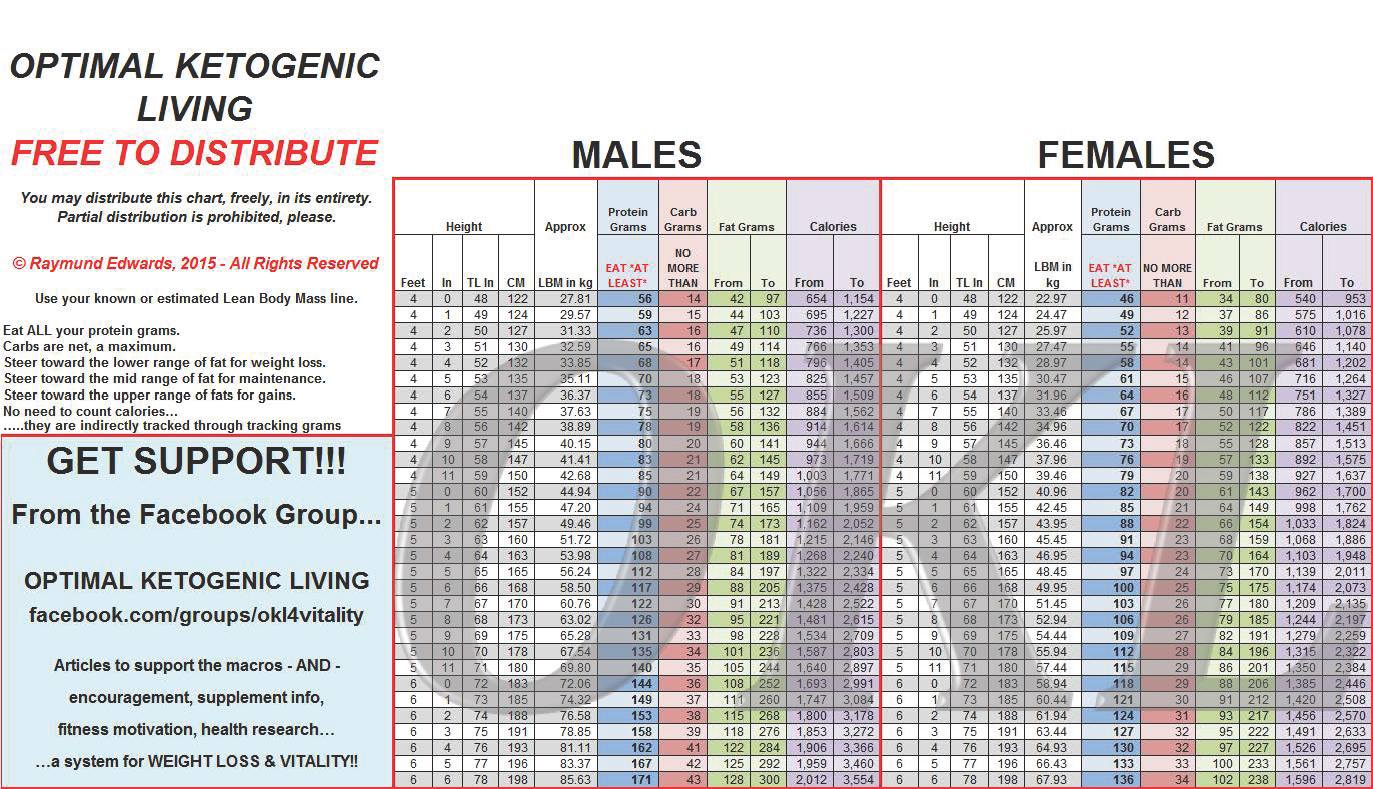
For protein, I will be following the advice of Jonathan Bailor, who I mentioned here, to keep nutrient-dense protein at 1 gram per pound of body weight.  For me, that would mean around 136g of protein per day for my current weight, and 125g of protein when I get down to my goal weight of 125 pounds.  Pretty simple, huh?  This also is in line with the recommendations of the Optimal Ketogenic Living Facebook Group (also mentioned in that same blog post) that is between 91g and 136g for a woman my height.

Carbs will probably always be very low, because I find that I can manage my blood glucose quite easily when I stay low carb.  Jonathan Bailor says to eat 10 servings of vegetables per day, but I'm not sure if that would be a good idea for me, so I will probably stick with the OKL recommendation of 23g of net carbs per day, which is total carbs minus fiber.  If I am eating that all in green vegetables, that is still quite a lot of vegetables, so I think I'm doing good in that department.

I am still sort of tracking my food.  I am getting used to how many grams of protein, fat and carbs I need to make a nice meal, so I am doing the math until I have a better handle on it.

FASTING

On the days that I don't meet my weight goal, I will be fasting.  Although some fasting gurus say that a fast is only water, others say that incorporating very low caloric liquids is okay.  I have decided that fasting for me will include water, coffee, tea and broth, all without added caloric sweeteners or fat.  I do allow myself to have a few drops of liquid Stevia extract in my coffee and tea.  It does not affect my BG, and I like it.  And you can't stop me.  I did it this way in the first three months of this year, and I suffered no ill effects.

My weight loss goal is now at a slower pace (about 50% slower), which should translate into more feasting and less fasting.  In this past few days, I ate two days in a row, which was not that frequent as time went on in the last challenge.  Since starting this, I have not fasted more than one day in a row, although that could certainly start to change again as I get closer and closer to my new goal.

I made a few charts to track my progress.  On the first chart, the grey line is my long term goal. The blue line is my actual weight.  The red line is my 7-day average. The second chart is a little heat map to show at a glance how often I have actually had to fast to achieve the results I am after. Click on any chart to enlarge it.


As for Rule #2,  part of this challenge is that I have also made some commitments to build muscle and increase insulin sensitivity.  I have committed to one day per week of heavy, slow motion weight lifting, using Body By Science as my guide.  I have committed to HIIT twice per week on the treadmill at the gym.  I have committed to taking 3-mile walks as often as I can, maybe twice or three times per week.  The weight lifting should take care of the "gaining muscle" portion of my new challenge, and the HIIT and walking should continue to help with my insulin sensitivity.  Notice that I am not trying to "burn calories" with my exercise.  I'm done with that nonsense.  It's not a problem of too many calories that need to be "burned off".  It is a problem with hormonal imbalance that keeps body fat trapped and unable to be used for energy.  The solution for that is to balance hormones, not to eat less and move more!

Below is my chart for The Big Five.  It shows the exercises I am doing, along with the weight, reps and TUL, which stands for Time Under Load.  The system is to lift weight very slowly up and down, and to attempt to exceed one minute and thirty seconds on each exercise.  Each time that goal is reached, you increase the weight by at least another 5% for the next session.  As you can see, I did not exceed 1:30 this past week, so there was no increase in weight.  One of the great things about lifting this way is that the whole thing takes about 15 minutes and you only do one set on each machine.  No more being in the gym for hours and doing multiple sets on each of twenty different machines!  In and out fast, with the same or better results.  My kind of workout!


Twice per week, once on the same day as weight lifting, and once a half week later, I do High Intensity Interval Training (HIIT) on the treadmill at the gym.  I begin by walking at 1.5 mph with 0 incline for about 2.5 minutes, then ramp up to a run for 30 seconds at over 6 mph (I keep increasing it each time) with an incline of 3.  After the run, I go back to the walk for 2.5 minutes, then back to the run for 30 seconds.  I do three of these intervals, ending with a walk, then a 5 minute cool down.  I am on the treadmill for a total of 17 minutes, including the cool down.


The last activity I am doing is walking, at a leisurely pace, around my neighborhood or other beautiful places, or, if it is yucky outside, I will get on the treadmill at the gym.  I would like to do this at least twice per week.  I found a cool app for my phone that tracks my route, along with miles per hour and total distance.  When I walk, I aim for around three miles in one hour.  Here is what a normal walk looks like, and below that is my walking log:


There are nine weeks remaining for this kindler, gentler challenge.  If I achieve my goal, I'm not sure where I will go from there.  Technically, my doctor wants me to weight 122 pounds with around 22% body fat.  At my age, I'm not sure that is possible, or even desirable.  It's fun to think about, but not if it means I have to live a life of deprivation.  I will be more than happy to reach my current goal.  Heck, if I stay where I am now, it will be a big health improvement from where I started, which, in case you forget, was here. 


This is a personal challenge just for me, but if anyone reading would like to join me, please talk to your doctor and make sure that it will not conflict with your current medical condition or medications.  If you are taking the challenge, please be sure to let me know how you are doing!  Thanks for reading!

Monday, April 25, 2016

BREAK TIME IS OVER - ON TO THE NEXT CHALLENGE!

My weight loss and blood glucose challenge came to an official end on April 1, 2016.  You can read the final results here if you haven't already.  Even though I came in a couple of pounds over my goal, it was so close that I consider the three-month challenge a rousing success!  I was able to lose a bunch of weight and, more importantly, I normalized my fasting blood glucose.

In case you are curious, for these past few weeks, I did some more fasting, lost some more weight, went on a mini vacation, gained some weight and saw one post-meal blood glucose reading get very high indeed, convincing me, once again, that I cannot eat sugar without damaging myself.

One of the things that I have been doing has been trying to follow the Optimal Ketogenic Living guidelines for the amount of protein, fat and carbs to eat each day.  If you join the Facebook group for OKL, you can learn more about how this way of eating works.

According to the OKL chart, shown here, a 5'3" woman like me should be eating between 91 and 136 grams of protein per day, no more than 23 grams of net carbs per day, and between 68 and 159 grams of fat per day.  This last guideline - for fat grams - is a sliding scale based on your weight goals.  If you want to lose weight, stay at or near the lower amount of fat grams.  If you want to maintain your current weight, stay around the middle.  If you want to gain weight, stay at or near the highest amount of fat grams.

Fasting, in many different forms, is encouraged in this group, and reading the many threads and research articles will give you a real education on nutrition.  The works of Drs. Phinney and Volek are highlighted and followed, and I highly recommend the folks at OKL!

I have also been spending a lot of time watching youtube videos on nutrition, fasting, protein needs and kittens.  (It would not be a good day if I did not watch at least one youtube video featuring kittens!)

One of the people I have been listening to is Jonathan Bailor.  I got his book from the library, but it may just end up being one that I need for my personal library.  I heard about Jonathan and his thoughts concerning the ridiculousness of counting calories last year.

I seriously considered trying his weight loss method, but when I found out that he is against counting calories, I was discouraged.  Each time I have tried a weight loss method that does not involve tracking every blankety-blank-blank bite of food I eat, I have always gained weight.

But, after listening to someone that I respect interviewing Jonathan, I decided to read his new book and see what I could glean from it.  I have to admit that I was impressed with what I read, which I did with a newly opened mind, and found that the vast majority of what he was suggesting was right in line with the OKL chart I have been following!

Jonathan's recommendations include eating plenty of nutrient-dense protein (about 1 gram per pound of body weight, which is at the high end of the OKL recommendation), LOTS of green vegetables, and other colors, too, and what he calls 'whole food fats'.  He is not a proponent of adding a lot of oils or butter to food, but rather, eating foods that have natural fats contained within them, such as avocados, olives, eggs, nuts, seeds, coconut, etc.

My fear was that, if I ate the amount of veggies he suggests, my blood glucose would spike up.  But, for the past few days, I have been stuffing myself with green veggies, mostly raw, and my blood glucose was only 95 mg/dl at the highest, which was two hours after eating.  So far, so good, so I am continuing on.

The basic premise of the nutrition portion of the book is to eat SANE food and avoid inSANE food.  Jonathan explains the difference quite clearly in the book, and on his website, and maintains that if you fill yourself up with (almost) unlimited amounts of SANE food, you will not have room for the inSANE food.   

I love Jonathan's take on exercise, too, possibly because he agrees with what I have already decided is the right way to exercise - lifting heavy weights very slowly, doing a little bit of High Intensity Interval Training (HIIT) now and then, and taking part in other activities that you enjoy, for stress relief, if for no other reason.  Waking, riding a bike, yoga, etc.

I have a new appreciation for the concepts outlined in "The Calorie Myth," so I have to give it a pretty sweeping recommendation.


Of course, Dr. Jason Fung is a particular favorite of mine as of late, and I am rather impatiently waiting for Amazon to deliver my copy of his long-awaited book, "The Obesity Code."  Dr. Fung has written extensively on diabetes treatment and prevention on his website, Intensive Dietary Management, and his videos, both on his website and on youtube, are thought-provoking, eye-opening and life-changing to thousands of people around the world.

Dr. Fung uses fasting, both short- and long-term, to manage blood glucose, insulin resistance and Metabolic Syndrome.  It was his factual reporting about the benefits of fasting that really pushed me over the edge into fasting to manage my Type 2 Diabetes.  Again, I highly recommend that all my readers look into what Dr. Jason Fung is uncovering.  His methods are really game-changing!

So, back to me and what I am doing next...

Encouraged by my recent challenge, and seeing that it is possible for me to lose weight and manage my blood glucose, I have decided that, after this past few weeks 'break' that I am going to jump back in and try to lose a few more pounds of body fat and gain a pound or so of lean mass.

Seeing a recent low weight of 133.4 pounds a couple of weeks ago, and a body fat percentage of 29.5, I have set my new goal at 130 pounds with body fat of 25%.  That translates to an additional loss of 11.1 pounds of body fat and an additional gain of 1.3 pounds of muscle.  Can I do it?  There is only one way to find out...

I have committed to one day per week of heavy, slow motion weight lifting, using Body By Science as my guide.  I have committed to HIIT twice per week on the treadmill at the gym.  I have committed to taking 3-mile walks as often as I can, maybe twice or three times per week, weather permitting.  The weight lifting should take care of the "gaining muscle" portion of my new challenge, and the HIIT and walking should continue to help with my insulin sensitivity.  Notice that I am not trying to "burn calories" with my exercise.  I'm done with that nonsense.  It's not a problem of too many calories that need to be "burned off".  It is a problem with hormonal imbalance that keeps body fat trapped and unable to be used for energy.  The solution for that is to balance hormones, not to eat less and move more!


 The chart to the left shows what my daily goals will be for my scale weight.  As you can see, the slope of the grey goal line is a little shallower now than it was for the first three months of this year.  My previous goal was to lose 0.2 pounds per day (on average), and, starting tomorrow, the new goal will be to lose only 0.12 pounds per day.  I am doing this to take a gentler approach to weight loss, to give my body a little break, and to give some loose skin a chance to firm up, which opportunity I certainly hope it will take advantage of!

From now until the end of June 2016, I will again be utilizing my Feast/Fast model, with one slight change - I will not be using fasting blood glucose as a determining factor of whether or not I fast on a particular day.  I really feel that I have increased my insulin sensitivity to the point where my blood glucose is stable, and although I will check it now and then, I will not routinely check it every morning to see whether or not I'm going to eat.

This time around, I will simply weigh first thing in the morning before I eat, and if my weight is equal to or less than my goal for that day, I will feast freely.  Even though I have been tracking my food intake for the past couple of weeks, just to get the hang of how much more protein and veggies to eat, and how much less fat to eat, I will stop tracking now and just eat in the amounts that I have become accustomed to.

And, speaking of fat, I do want to mention that I was eating a lot more fat in January, February and March than I have been eating lately.  (I am also eating a lot more protein, which has been shown in studies to aid in weight loss.)  I finally got it through my head that there is enough fat on my body to "eat" and I don't need Bullet Proof Coffee and Fat Bombs at this stage of my weight loss.  As I have heard said, all I need is Low Carb; I'm already High Fat!  The fat on my body will be utilized for energy until there is not an excess amount of it.  Each time I eat a bunch of fat, my body will burn that rather than the stores of fat already "on hand."  Eating less fat does not make this a low fat diet.  I am just eating the fat on my body instead of the fat on my plate.  And, even with the whole food fats that I am eating, around 50% or more of my calories are coming from fat, so even that is still considered a high fat diet.

When I get to the point were there is not a lot of excess fat on my body, I will get to increase fat to supply the energy I need to live.  I'm looking forward to that!  I do miss my BPC!


One more chart.  This is an extended Feast/Fast Heat Map, so that you can see at a glance how often I am fasting.  This chart starts on January 1, 2016 and ends on June 30, 2016.  One red block represents a 36-hour fast.  Two red blocks in a row represent a 60-hour fast.

As you can see, I have feasted for the past seven days in a row.  What a luxury!

All that will come to an end as I start my fasting again.  So I better get used to seeing a little more red and a little less green.

When I did my last challenge, I posted every day.  This time, I will probably post only once per week.  Even I get bored with mundane details every day!

My next post will be a week from now, and I will tell you how I am doing, and show you my charts.  I will be adding in an activity log that will show how my weight lifting is going and how many times I have done HIIT and how many walks I have gone on.

Oh, and I just want to give a personal thank you to my friend Lynn Weiler, who has been a real inspiration to me and gave me the little nudge I needed to start back up again.  And she is joining me in this challenge, so, with her permission, I may be sharing some of her results as well!  Thanks, Lynn!

This is a personal challenge just for me, but if anyone reading would like to join me, please talk to your doctor and make sure that it will not conflict with your current medical condition or medications.  If you are taking the challenge, please be sure to let me know how you are doing!  Thanks for reading!

Sunday, July 19, 2015

NUTRITIONAL KETOSIS SHORT WEEK UPDATE

Since I only started Nutritional Ketosis again four days ago, I just want to post this update and talk about how I will eat in this coming week.

On the first day - July 15, 2015 - I did a full day's monitoring of my blood sugar, to get a baseline for the future.  Here are the results:

(click chart to enlarge)

As you can see, my average blood glucose for the day was only 79, which is great, and the highest it went all day, even after eating, was only 90.  Well within optimal range!  I also added a chart above that shows what I ate at each meal, so I can see how the macros of fat, protein and carbs impacted my blood glucose.  The levels that I ate on this particular day did not cause any problems.

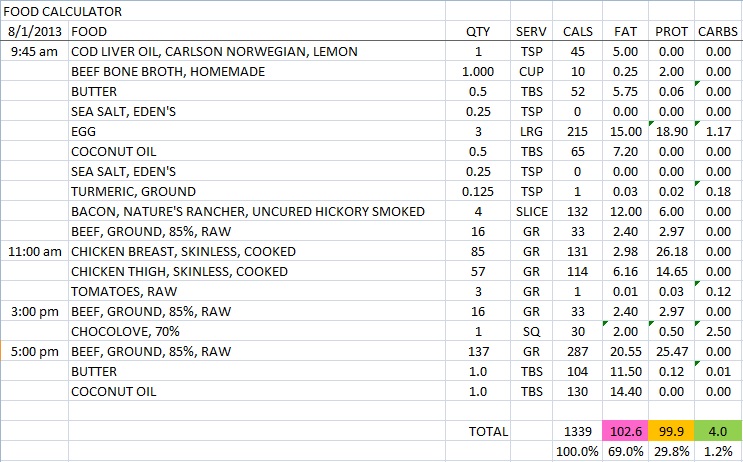
Here is what I actually ate on that day:

(click chart to enlarge)


So food is good, blood glucose is good, but what happened to my body composition in the past four days?

July 15, 2015
Neck - 12"
Bust - 36"
Waist - 31.75"
Belly - 39.75"
Hips - 40.25"
Thigh - 22.5"
Calf - 14.25"
Scale weight - 146.2 pounds
Body fat - 52.7 pounds - 36%
Lean mass - 93.5 pounds - 64%

July 19, 2015
Neck - 12"
Bust - 36"
Waist - 31.625"
Belly - 39.5"
Hips - 40.125"
Thigh - 22.25"
Calf - 14.125"
Scale weight - 144.4 pounds
Body fat - 51.6 pounds - 35.8%
Lean mass - 92.8 pounds - 64.2%

In the past four days, I have lost 1.1 pounds of body fat, but I have also lost 0.7 pounds of lean mass.  I would rather have lost less weight on the scale in order to have not lost muscle.  This muscle loss came after eating only 66 grams of protein for the day.  I was basically having only Bulletproof Coffee for one meal and splitting my protein allowance for the day between the other two meals.

The reason for partitioning my macros this way is to make sure that I am eating at least 30 grams of complete protein at each of my two main meals.  The idea for this came from Dr. Donald Layman, PhD.  In this video, Dr. Layman explains why it is necessary to eat at least 30 grams of protein at each meal in order to achieve protein synthesis.  Dr. Layman says that it is necessary to eat three meals per day, with at least 30 grams of protein at each meal, but I am questioning if this is a good idea for a Type 2 Diabetic.  Most of the ketogenic diabetes blogs I am following say to eat much less than 90 grams of protein per day to keep high blood sugar at bay.  So I am going to experiment on myself with a new n=1.  I am going to "sneak up" to eating more protein at each meal, until I get up to the 90 grams of complete protein (this would be protein that contains all the essential amino acids, but not the protein that comes as part of the vegetables that I eat, which are incomplete proteins), or until my blood glucose starts increasing, whichever comes first.  So here is my plan for this coming week:

Breakfast (Bulletproof Coffee with whey protein isolate):
437 calories
43.5g fat (89.7%)
10.7g protein (9.8%) of which 10g are complete protein
0.6g net carbs (0.6%)

For lunch and dinner, I will eat whole foods.  For each of these two meals, I will budget 30g of complete protein, plus whatever small amounts of incomplete protein are contained in vegetables.

I will budget no more than 5g of net carbs for each meal.  If I fall short on carbs at lunch, I will not try to make it up at dinner.

As far as fat goes, I am a little on the fence about it.  Part of me thinks that I should hold the fat low in order for my body fat to get burned, and part of me thinks that I should keep fat higher, to make my food more palatable, and to keep more in line with a true ketogenic diet.  Two schools of thought.  Looking back at my old food and weight loss logs, I see that having more fat did not stop weight loss or muscle gain, so I am not going to restrict fat.  I am also not going to force fat in order to get it up to a certain percentage of my food intake.

What I am going to do is eat the amount of fat that seems right for each meal, and let the grams fall where they may.  For instance, I am having quite a bit of fat at breakfast.  If I eat a salad with protein for lunch, I will add enough oil in my homemade salad dressing to balance the apple cider vinegar I use.  That seems to be about 4-1/2 teaspoons of oil for the 4-1/2 teaspoon of vinegar.  If I eat protein with a cooked vegetable, I will use a tablespoon of fat of some kind on my meat, and another tablespoon on my vegetables.  For "dessert", I will treat myself to one of my fat bombs, which is one of the recipes I contributed to "The Fat Fast Cookbook".  (shameless plug)


Lunch (green salad with homemade dressing and some sort of protein):
560 calories
43.9g fat (70.6%)
36.1g protein (25.8%) of which 30g are complete protein
5g net carbs (3.6%)

Dinner (cooked protein and vegetables with butter, oil, lard, etc.):
621 calories
52.2g fat (75.6%)
32.8g protein (21.1%) of which 30g are complete protein
5g net carbs (3.2%)

The total for the day, based on this example:

1618 calories
139.7g fat (77.7%)
79.5g protein (19.7%) of which 70g are complete protein
10.7g net carbs (2.7%)

(Edit at the end of the day)  Here is a chart to show how I ate today and how it affected my blood glucose, which is not much!

(click to enlarge)

My plan for the future is to try to keep increasing protein each week.

Week 1:  70g of complete protein (10 breakfast, 30 lunch, 30 dinner)
Week 2:  80g of complete protein (20 breakfast, 30 lunch, 30 dinner)
Week 3:  90g of complete protein (30 breakfast, 30 lunch, 30 dinner)

By the time I get to Week 3, I should be up to the 30g of complete protein per meal that Dr. Layman recommends that I eat.  It remains to be seen if my blood glucose will stay under control doing this.

Oh, I almost forgot...

WHAT ABOUT HUNGER???

As soon as I started eating this way, I noticed that the only time I am hungry is first thing in the morning on the days I have to get up at 4 am but do not have breakfast until 8 am.  Why do I wait to eat?  Because I just can't eat a full breakfast before dawn, and if I did, it would mean getting up even earlier that 4 am to prepare and eat before leaving for work at 5 am.  Not only that, but I am not able to have lunch until I get home around 1:30 pm, and if I ate at 4 am, there would be a 9-1/2 hour break before lunch.  So, I have a cup of broth at 6 am at work, then have a cup of coffee at 7 am, then eat the breakfast I brought from home at 8 am.

Calorie reduction makes me hungry.  This way of eating suppresses hunger.  On the four days a week that I do not leave the house to go to work, I eat around 8 am, 1 pm and 6 pm.  I do not snack at all in between, and I am never hungry.  Being in a state of ketosis will do that for you!


I'll try to post again in a week to let you know how it went for the week.

Thanks for reading!

This photo, by the way, was taken by my wonderful husband on our 40th Wedding Anniversary on October 27, 2014.

Monday, July 13, 2015

NUTRITIONAL KETOSIS REVISITED

It's been so long since I wrote a real post here on the big blog, that I doubt that anyone is still reading!  But, even if it is just for myself, I'm going to write a little bit about how things have been going.

As is my pattern, I seem to get ridiculously close to my goal body fat, and then it all falls apart and I gain some of the body fat back.  Sigh.  And here is the reason it always happens:  I stop tracking what I am eating and try to eat instinctively.  That seems to work for a lot of people, and it seems to be the advice that is always given to people eating the LCHF way.  The only problem is that when I can't seem to do that, I feel like a failure.


I suspect that there are a lot of people like me, that are so messed up, metabolically speaking, that they will have to be vigilant for the rest of their lives if they want to stay trim and healthy.  So why does everyone say that, after an adjustment period, a person should be able to let their appetite be their guide?  This is my theory about that:  If the LCHF experts told people that there was a chance that they were going to have to micromanage their food intake for the rest of their lives, they would probably not even try to begin with!

Anyway, since getting back from vacation at the end of February of this year, I have been trying to return to some of my old "systems" of eating.  I have even tried a new one, called "Optimal Ketogenic Living" which a friend told me about because it has been working for her.

Two small problems with this plan:

1. I did not lose any significant weight doing it, and

2. The plan involves eating almost three times as much protein as I had been eating when I was doing Nutritional Ketosis, as recorded in this blog.  It also involves eating a lot less fat.  All lean meats and virtually no added fats, so no butter, mayo, coconut oil, fat bombs, etc.

Ninety-nine per cent of the research I have read has said that too much protein will knock you out of ketosis.  Not only that, but excess protein will be converted to glucose and raise insulin and blood glucose.  The Optimal Ketogenic Living group (OKL) says that this is a lot of hooey, and there is no research that supports those ideas.  My regular readers might remember that I was diagnosed with Type 2 Diabetes three years ago, so keeping my blood glucose low has been a priority.

In the OKL way of looking at things, the small (in their opinion) amounts of protein that are recommended by the "popular keto" advocates are way too small.  The last time I was seriously doing Nutritional Ketosis, I was only eating 54g of protein per day, along with 135g of fat and 27g of total carbs.  The recommendation for my height of 5'3" by the OKL group is 63g of fat, 91-136g of protein and 23g net carbs.

I tried this, and eating only 63g of fat per day was impossible without eating lots of egg whites, skinless chicken breast and 95% lean ground beef.  The thinking is that a person is still eating high fat, but the fat is coming from their body and not from their plate.  As a person nears their goal weight, they will start to increase fat until weight stabilizes.  But until it does, it felt very low fat to me!  But eating more grams of fat than protein while trying to lose weight with OKL was anethema.

I do want to mention that there are a LOT of people in that Facebook group that are doing wonderfully well with this way of eating, including the friend that suggested it to me, and if anyone wants to try it, I would say to go for it.  I do not think it was a bad plan.  I was just not enjoying it, and my weight was going up and down.

The thinking about protein is that a person must eat at least 30g of protein with each meal, in order to signal mTOR (the way that the body rebuilds, but others say to keep it below that, because signaling mTOR is a bad thing, which will cause other growth, such as body fat and even cancer!).  There is so much mixed research about this, that I am totally confused.  Is signaling mTOR good or bad?  All I know is that when I was eating less than 30g of protein at each meal, I was losing body fat and gaining lean body mass.

As I was trying to adjust to OKL, I also got involved with a couple of Diabetes Facebook groups.  In each one, when I told them that I was eating over 100g of protein per day, there was horror all around!  My blood glucose will go through the roof (they warned) and I will develop breast cancer!

Well, I have been checking my blood glucose, and that amount of protein was not causing any spikes.  And, the last time I checked, I have not developed breast cancer.  Of course, their answer to that is that I won't know until it's too late!  Sigh.  Again.

Here is the thing:  I have been pouring over my vast records of every LCHF plan I have tried, and the fat loss that resulted from each one, and the one that seems to have been the most successful was - you guessed it - Nutritional Ketosis.  For me, that is 135g of fat, 54g of protein and 27g of total carbs, not net carbs.  I knew I didn't want to do this again, because my memory tells me that it was no fun and that I was hungry all the time.  But, today I looked back on every post that I wrote about it, and was reminded that I was happy, healthy and un-hungry while I was doing it.  Hmmm...

So, I guess I'm going to start doing that again.  And we will see what happens.  From what I have read, I was eating a pretty fatty breakfast, a fat snack around lunch, and a LCHF dinner in the evening.

Looking back, I also noticed that since I re-engaged NK in 2013, I changed my goals to varying amounts of fat and protein, with the fat being between 110g and 137g and the protein being between 56g and around 100g.  I'm not sure why I was fluctuating that much with my goals from week to week, but when I looked at the resulting weight loss, it was working, even when the fat was slightly lower and the protein was slightly higher.

To get me started, I guess I will start at the beginning, the way I was doing it then, back in the summer of 2012.  As I go along, I will continue to monitor my blood glucose, and if it is possible to begin raising protein without  raising blood glucose and/or gaining body fat, I will raise protein.  I can say that I will miss eating the amount of protein that I have been eating.  It was fun! 

I can't promise when I will post again, because I'm sure I will have similar results as the last time I did this, and I don't want to bore anyone with identical details, but I will leave you with this:

April 15, 2015 stats:
Neck - 12.125"
Bust - 37.5"
Waist - 33"
Belly - 40.5"
Hips - 41.25"
Thigh - 23"
Calf - 14.5"
Scale weight - 149.6 pounds
Body fat - 57.6 pounds - 38.5%
Lean mass - 92 pounds - 61.5%

July 8, 2015 stats after 12 weeks on OKL:
Neck - 12.125"
Bust - 36"
Waist - 31.75"
Belly - 39.75"
Hips - 40.25"
Thigh - 22.5"
Calf - 14.25"
Scale weight - 146.4 pounds
Body fat - 52.6 pounds - 35.9%
Lean mass - 93.8 pounds - 64.1%

So, in the past 12 weeks on OKL, I lost 5 pounds of body fat and I gained 1.8 pounds of lean mass.  That's less than a half pound of body fat per week.  Not that there is anything wrong with that, but eating lower fat was making me unhappy, and I lost better and quicker eating more fat and less protein.

To reach my goal of 136 pounds with 30% body fat, I need to lose another 11.7 pounds of body fat and gain another 1.3 pounds of muscle.  The muscle should be the easier part - I'm starting back at the gym, lifting weights, this week.

So here goes...

Wish me luck!

(If you are a first time reader of my blog, click on the tag below for Nutritional Ketosis, and it will take you to other posts from my past experiences with that way of eating.)


Sunday, August 4, 2013

ZERO CARB - WEEK 2 RESULTS


Just eat meat.  

That is what I have been doing for two weeks now.  Well, mostly meat, anyway.  As you can see by my food diaries below, there were two days that I ate a few bites of vegetables and a few days that I ate a few bites of dark chocolate.

Here are my food logs:

On July 28, I ate beef, fish, eggs, homemade beef bone broth, healthy fats, cod liver oil and water and found that my blood sugar was very stable and in the acceptable range, even though I ate some cheese.  I also checked my blood ketones in the morning, and they were 0.9.  Not as high as I would like, but still in the ketosis range.

(click chart to enlarge)

On July 29 through July 31, I ate beef, fish, eggs, homemade beef bone broth, healthy fats, cod liver oil and water.  I did not check my blood glucose every day, because I know that eating this way is keeping my blood glucose stable and at a good level.  I did check it on July 31 an hour after dinner, and it was 85.

(click chart to enlarge)

On August 1, I ate beef, chicken, eggs, homemade beef bone broth, healthy fats, cod liver oil and water.  I also ate 1 grape tomato and 1 small square of 70% dark chocolate.

(click chart to enlarge)


On August 2, I ate beef, polish sausage, homemade beef bone broth, healthy fats, a small amount of lemon juice, a few drops of Stevia extract, cod liver oil and water.  I also ate 1 small square of 70% dark chocolate.

(click chart to enlarge)

On August 3, I ate polish sausage, eggs, beef, a dill pickle spear, a few bites of salad, homemade beef bone broth, healthy fats, cod liver oil and water.

(click chart to enlarge)

BLOOD KETONES

At 9:30 pm on August 3, I checked my blood glucose and blood ketones.  I know that it was a few hours since I had eaten, but I did it anyway.  My blood glucose was 72 and my blood ketones were 4.3.  I have never had a ketone reading this high before, so I am pretty happy about that.  I usually only check it in the morning, and it is a lot lower than that!  Evidently, eating a couple of bites of vegetables and a couple of bites of dark chocolate did not kick me out of ketosis.


MY EXCESS BODY FAT 

As I mentioned last week, my main concern is that I regulate my blood sugar, but I still have too much body fat and I'm hoping this way of eating will help me in that regard. 

I decided at the beginning of this past week that I was going to stop weighing on the bathroom scale, because knowing what you weigh outside of knowing your body fat percentage is pretty useless.  So I am going to continue measuring my neck, waist and hips to get my approximate body fat percentage using this free, online calculator.  That way I will be able to track my progress in a more meaningful way.  So, my charts below will not show what I weigh or how many pounds of body fat and/or lean mass I have gained or lost.  Here are my charts:


As you can see, my body size is pretty much going nowhere.  This coming week, I am going to change what I am eating a little bit to see if I can get things moving.  These are the average macronutrient intakes during Weeks 1 and 2:

(click chart to enlarge)

This week, I am going to adjust my food to the following:

1440 Calories
120g fat (75%)
90g protein (25%)

I am tempted to go back to eating around 60g of protein per day, but I want to keep trying to be able to eat more protein than that.  And since I know that I am in ketosis even when I am eating more than 100g of protein, I am only going to cut it back a little bit to see if I can shake things up.  The last time I was losing well, I was eating around 60g, but I may be able to eat more than that, so I'll see how things go this week.

I am lowering the fat grams just a little, in the hope that it will encourage my body to burn some of its own fat instead of the fat I am eating.  I may just be getting a little too much fuel.  Again, we'll see.


STILL NO VEGGIES

Aside from the couple of bites I had of vegetables this past week, I am still zero carb and feeling okay about it.  I am not really missing vegetables, so I am going to not eat any this week.

RELATED POST:  Zero Carb Results by Week

Sunday, July 28, 2013

ZERO CARB - WEEK 1 RESULTS


 A little over a week ago, I was diagnosed with Type 2 Diabetes.  I was both surprised and not surprised at the same time.  The doctor said he did not mean to offend me or upset me by telling me this.  I assured him that I was neither.  It really does answer some questions for me, like why I have had such trouble losing weight and why my blood sugar raises into diabetic levels unless I eat extremely low protein and low carb.  Also, there is a genetic component to this disease, and my maternal grandmother was a needle-carrying Type 2 Diabetic, and others in my family appear to have developed the disease, but have not been diagnosed.

During the time that I have been doing Nutritional Ketosis, I have been periodically checking my blood sugar with a home glucose meter, and I have found that eating around 130 grams of fat, 57 grams of protein and less than 25 grams of carbohydrate per day has kept my blood sugar at an average of 86, including both fasting and after eating.  Eating this way has also kept my blood ketones in the ketogenic level, meaning that I am burning ketone bodies for fuel instead of glucose.  So that's good.

But wait, there's more...

The reason I started Nutritional Ketosis in the first place was that I suspected that I was eating too much protein.  And testing ketones did confirm to me that eating about half of the amount of protein that I used to eat did, indeed, raise my blood ketones and lower my blood sugar.  Both good things.

I do lose weight and feel good eating this way, but there is a problem...  Although, at first, I found that my appetite had been satisfied with this small amount of food, it has become increasingly difficult to feel satiety after eating.  In other words, I'm hungry!  Plus, with eating this small amount of food, I really have to only eat twice per day in order to get more than a few bites of meat at each meal.

So when my doctor advised me to change the way I was eating, I was all ears.  He said, simply, to...

Just eat meat.

He said that he, himself, just eats meat.  He said that he eats steak for dinner with a side of chicken.  Interesting!  I have been thinking about starting a zero carb way of life for several weeks and have been reading up on it, so, starting on July 21, I took the challenge to go Zero Carb, which does not mean literally no carbs, but only the trace carbs that come from animal products.  I am eating meat, a small amount of dairy, some healthy fats and I am drinking water only.  I am testing my blood sugar before meals and two hours after meals to see how I am reacting to cutting out all vegetable and berry carbs and increasing my protein substantially.  I am carefully tracking what I am eating.

Here is what I have learned so far about how my blood sugar reacts to food:

On July 22, I ate meat, healthy fats and water and found that my blood sugar was very stable and in the acceptable range, only a few points over my normal of 86.

(click to enlarge)


(click to enlarge)
 On July 23, I added some dairy to each meal, based on my recent discovery that I am moderately intolerant of dairy, and I eat it no more often than every four days.  I also had some bacon for breakfast that had more sugar in it than my regular bacon.  My blood sugar was less stable, and close to 100 at times.  It is either the sugar in the bacon or the dairy that caused this.

(click to enlarge)
(click to enlarge)
 On July 24,  it was back to just meat, healthy fats and water to drink, and my blood sugar went down with each reading, into a very nice range.

(click to enlarge)
(click to enlarge)
On July 25, it was just meat, fat and water to drink, but I did try having the more sugary bacon for breakfast, and it raised my blood sugar.  The next time I eat dairy, I will then see if the dairy also raises it.

(click to enlarge)
(click to enlarge)
On July 26, it was meat, fat and water as usual.  I saw a little bit of instability, but I'm not sure why.  At any rate, it was still in the acceptable range.

(click to enlarge)
(click to enlarge)
On July 27, something interesting happened.  I ate dinner at a friend's house, and although I passed on the cake and ice cream dessert, I did have about a serving of vegetables and a very small salad.  With only that small amount of vegetables, I was surprised that my blood sugar went up to 110.  I know that it is not extremely high, but it is higher than what I am used to, and higher than a non-diabetic would get after eating a few bites of low-carb vegetables.  I had been wondering what would happen if I ate vegetables, and now I know.  I had been toying with the idea of putting veggies back into my diet, but I think I will wait a while before I think about that again.

(click to enlarge)
(click to enlarge)

So this is my experience so far with eating zero carb.  Although the main reason I am doing this is to manage my blood sugar and be able to remain diabetic complications free, I also am hoping that it will help me lose these last few pesky pounds.  Along those lines, how did I fare eating zero carb?

I started new charts to show my progress.  You know how I love my charts!  Here they are, after the first week on ZC:


The charts speak for themselves, so I won't say much, except that my body size is going down.

RELATED POST:  Zero Carb Results by Week