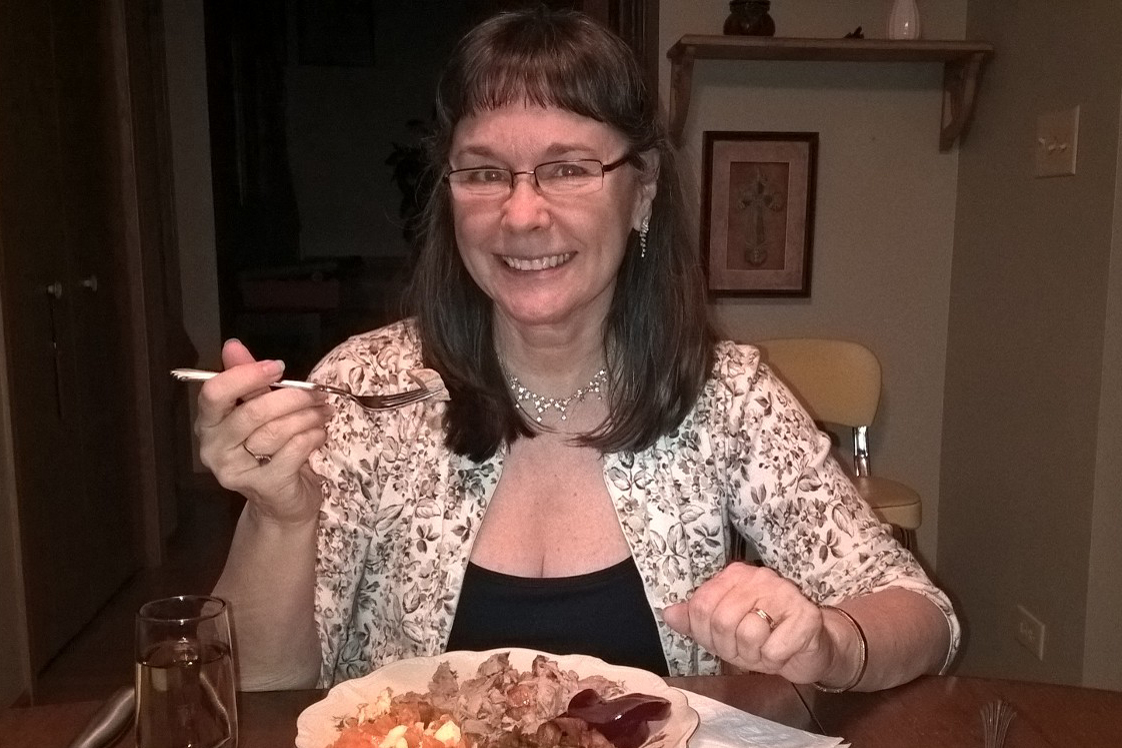
I had a bad incision during my c-section in 1977, and my stomach muscles were cut in such a way that I will never really be able to use them to hold my stomach in. Because of that, I will probably always have a little bit of a "pooch" no matter how slim I am, but I can live with that. Some tummy-control undies go a long way to giving me the impression of a flat stomach. By the way, I am not wearing anything like that in either of these photos. I am wearing regular, non-slimming leggings.
MY BODY MEASUREMENTS
Another thing that I have been doing in the background during the challenge is tracking my body measurements. Here are the results for those:
NECK
12 3/8" - 11 3/4"
LOST 5/8"
BUST
36 3/4" - 35"
LOST 1 3/4"
WAIST
33 3/4" - 29"
LOST 4 3/4"
BELLY
41 1/2" - 37 1/8"
LOST 4 3/8"
HIPS
41 1/4" - 38 1/4"
LOST 3"
THIGH
22 7/8" - 21 1/4"
LOST 1 5/8"
CALF
14 3/8" - 13 5/8"
LOST 3/4"
TOTAL INCHES LOST - 19 1/4"
When I do the math for the total inches lost, I count each measurement as one unit with the exception of my thighs and calves, which I count as two units each. Because I have two of each of those. That might not be the right way to do it, but it is the way I do it.
SCALE WEIGHT AND BODY COMPOSITION
Before I talk about my weight loss, I want to explain how I determine my body fat and lean body mass percentages.
In the past few years, I have had DEXA scans and Bod Pod testing done to determine my body composition. These are very accurate, but are expensive, usually costing around $100, depending where you get it done.
Several years ago, I found an online calculator that is used by the US Navy and is based on neck, waist and hip measurements. I tried it out and found that the results, at least for me, were so similar to the expensive tests that I decided to start using the free online calculator to get an estimate of my body composition. In my experience, I have found the free results to be within a few tenths of a percentage point of the other tests. For my purposes, this is close enough.
My goal for the past several years has been to reach my goal of 136 pounds with 30% body fat. When trying to lose weight, the goal should be to lose body fat and not lean mass. So knowing what your body composition is starting and ending is very useful. Here are the results for those:
January 1, 2016
60.1 pounds of body fat - 39%
93.9 pounds of lean body mass - 61%
154 pounds of total scale weight
April 1, 2016
41.7 pounds of body fat - 30.3%
95.9 pounds of lean body mass - 69.7%
137.6 pounds of total scale weight
LOST 18.4 POUNDS OF BODY FAT
GAINED 2 POUNDS OF LEAN BODY MASS
The way I see it, I have come close enough to my weight loss goals to declare this part of the challenge a victory. Technically, I still need to lose 0.9 pounds of body fat and I am actually over my goal for lean body mass by 0.7 pounds.
Because my lean body mass is over my goal, I need to make a shift in my goals. Now, the new goal is to achieve 30% body fat regardless of my scale weight. To reach this goal, all I need to do is lose another 1/4" from my waist.
By the way, according to my measurements, I am the smallest I have been since starting low carb in 2009, and also the smallest I have been in around twenty years. Before now, the lowest body fat percentage I achieved was around 32% and that was three years ago, but I gained the weight back. This time, I am bound and determined not to do that, no matter what it takes.
One thing that I want to be sure to mention is that I purposely did not do any kind of exercise during the challenge. I did not want there to be any confounding factors pertaining to my results.
The chart below is the final chart that shows my scale weight results. The grey lines are my long
term goals. The blue lines are my actual results. The orange lines are
my 7-day averages. As you can see, I came very close to reaching my goal.
FEASTING AND FASTING
When I started this challenge, I really had no idea that I would end up fasting as often as I did! I even said that I was going to fast at least once a week, even if I was meeting my goals for weight loss and FBG. Little did I know that I would end up fasting three, four and even five times per week to reach my goals! Here is my little heat map to show how often I needed to fast to achieve my goals:
I have said it before, but it bears repeating, that if I had known this going in, I wouldn't have started. I probably would have just started micromanaging my food intake again, lost some weight, gotten sick of it, quit tracking and then gained all the weight back again.
I have fasted in the past, and I knew I could do it, but it is still hard to start doing it again once you haven't done it in a while. I went in with a lot of commitment and drive and made it to the end, even when it was difficult. But how often was it difficult? Surprisingly seldom, to tell the truth. For me, once I started and my body adjusted to it, I rarely got truly hungry, and I could even be around other people (most notably, my husband) when they were eating and I would not feel anything.
In the evening, after a full day or two of fasting, I would start thinking about how wonderful it would be to eat in the morning. Then I would get up in the morning and not be hungry at all. This is one of the blessings/curses of fasting and being in deep nutritional ketosis. Running on ketones instead of glucose is a big appetite suppressant! Very often, I would have to force myself to eat something when I was not hungry. If there was one downside to having a suppressed appetite, it was the concern that I was not going to be getting the nutrition I need.
Obviously, though, I was able to maintain my muscle mass while losing body fat, even though I was eating only every few days for the last half of the challenge. I even gained some lean mass!
WHERE I AM GOING FROM HERE
As I mentioned at the beginning of this post, I intend to keep eating a ketogenic diet. But will I continue to feast and fast, or will I go back to caloric restriction, which is eating a smaller amount each day and tracking my food? I would like to look at the pros and cons of each.
FEASTING AND FASTING
Pro - On a feast day, I never have to count calories or grams of anything or weigh food.
Con - On a feast day, I sometimes don't want to eat and worry about getting nutrition.
Pro - On a fast day, I don't even have to think about food. Or pay for it!
Con - On a fast day, I don't get to eat if I want to, and I have to watch others eat.
Pro - On either day, my metabolism stays strong and does not slow down.
Pro - This way of eating seems to be sustainable. I may not feel like I need to give up.
CALORIC RESTRICTION
Pro - I get to eat every day.
Con - I have to measure everything I eat and track it on a spreadsheet.
Con - I have to stop eating when I am not satisfied.
Con - I have to pay for food every day.
Con - This is not a sustainable way for me to live. I hate it and I always give up.
And the biggest con of all - Caloric restriction has been shown to slow the metabolism, meaning that the longer you restrict calories, the slower the metabolism and the less food you get to eat to try to maintain your weight.
I found this to be true for myself. In the past, even when eating low carb, I had to continually reduce the amount of food I was allowed to eat in order to keep losing weight. I'll leave it to others to get into the science of why that is true, but I know it is and I have read many articles about the subject.
So, as nice as it seems to be able to eat every day, I think that the preponderance of the evidence in my case is that I need to continue to feast and fast to maintain a healthy body composition and normal blood glucose. This is what I have decided to do, and I can only hope that it will be sustainable over time. I have done it for three months without too much drama, so it is sustainable so far.
From here on out, I will not be using the bathroom scale as the measure of my success. Starting next week, I am going back to the gym once a week to do my weight training and I will also be starting a walking regimen to help with insulin resistance.
Because I intend to gain more muscle (and hopefully tighten up my loose skin!), I know that the number on the scale may start increasing. However, even as I gain muscle, my body size should not increase. For that reason, I will be using my body fat percentage as a guide of whether or not to eat on a given day. Using the free online calculator mentioned in this post, I will check my neck, waist and hip measurement each day and use those numbers in my decision for feast or fast. If the scale is over 136 pounds, but the calculator says that I am still 30% body fat, I'm feasting. If it is 30.1% or higher, I'm fasting.
The only drawback of this is that I am basically going by my waist measurement, and the day after I feast, I always feel a little bloated, which may be due to water weight and not true body fat gain. Also, like I mentioned earlier, my stomach muscles don't work very well, and just having food in my stomach, even the right kind of food, makes my tummy stick out. But, I figure that if I am fasting each time my waist measurement goes up a little, it will be good for me. Fasting is good for me. I need to keep telling myself that!
Throughout this challenge, as I was needing to fast more and more often, I have been concerned that I would need to keep up only eating a few times a week in order to maintain my health. But I'm thinking that it may not be the case, because I am now no longer needing to lose weight. When the challenge was in full swing, and I gained weight after a feast day, I would not only have to "fast off" that weight, but also an additional 0.2 pounds to keep up with my weight loss schedule. Now, if I gain weight (and by that, I mean body fat) on a feast day, all I need to lose the next day is that same weight and no more.
I fully expect that I will be transitioning into a regular pattern of Alternate Day Fasting. I hope that it will go well enough that there may be times that I eat two days in a row, but if not, so be it.
 |
| Rebecca on April 2, 2016 |
Well, I guess that's about all there is to my summary. It's been a great three months! I learned a lot, and I lost a lot. I hope there has been enough content here that my challenge has been food for thought for those that feel like they are stuck and don't know what to try next or where to turn.
Thanks so much for reading and for sticking it out with me for the full challenge!
Oh, and just in an effort at full disclosure, I must admit to my faithful readers that I went out to a restaurant and to the mall on April 1st, the first day being off the challenge, and I ate things I should have not eaten. It's all a blur now, but I have vague memories of a few French fries, some popcorn and a Dark Chocolate Pixie from Fannie May.
I gained weight. I fasted on April 3rd and 4th. Today I am eating and checking my blood glucose before and after eating. Onward and downward!